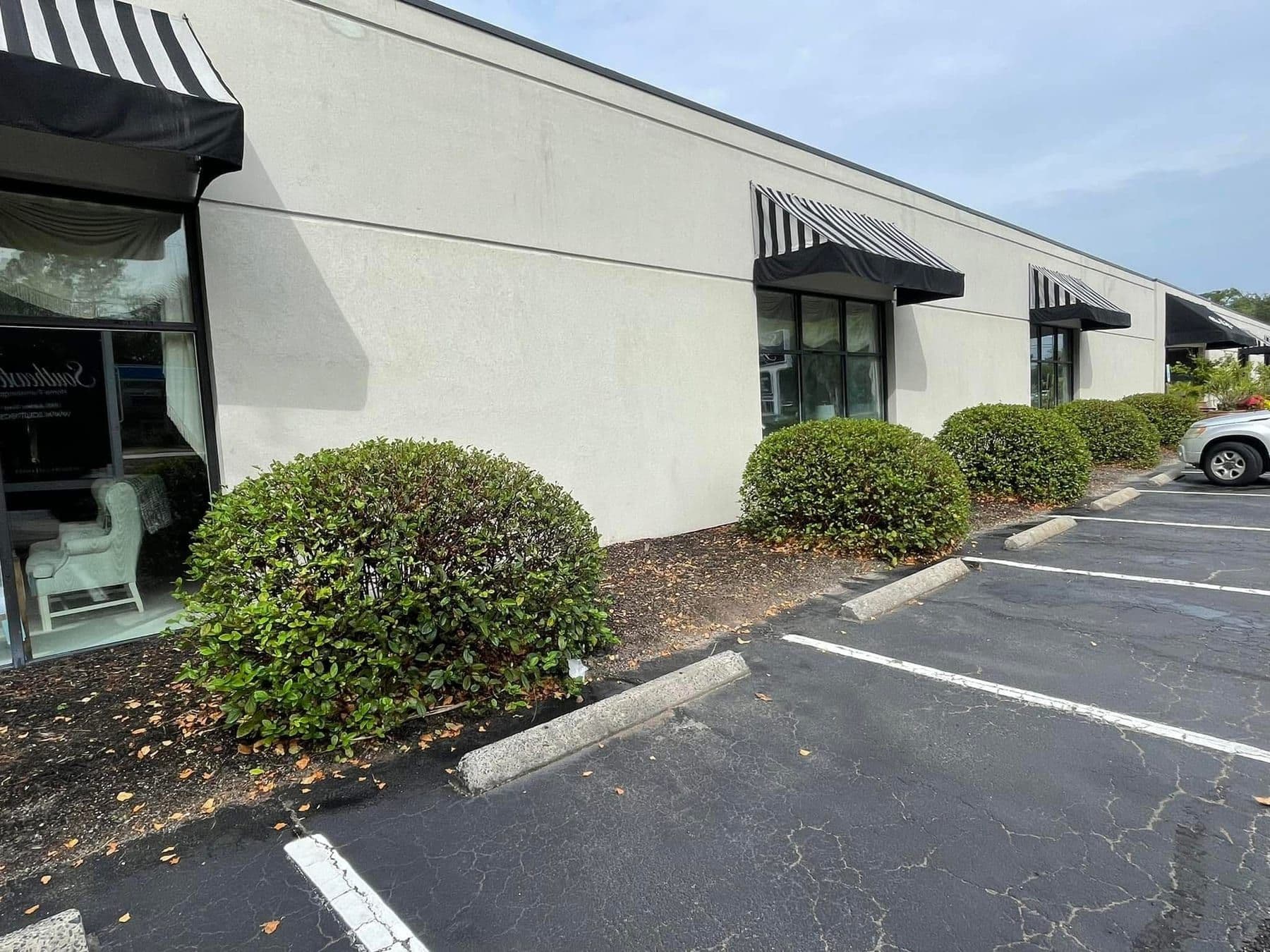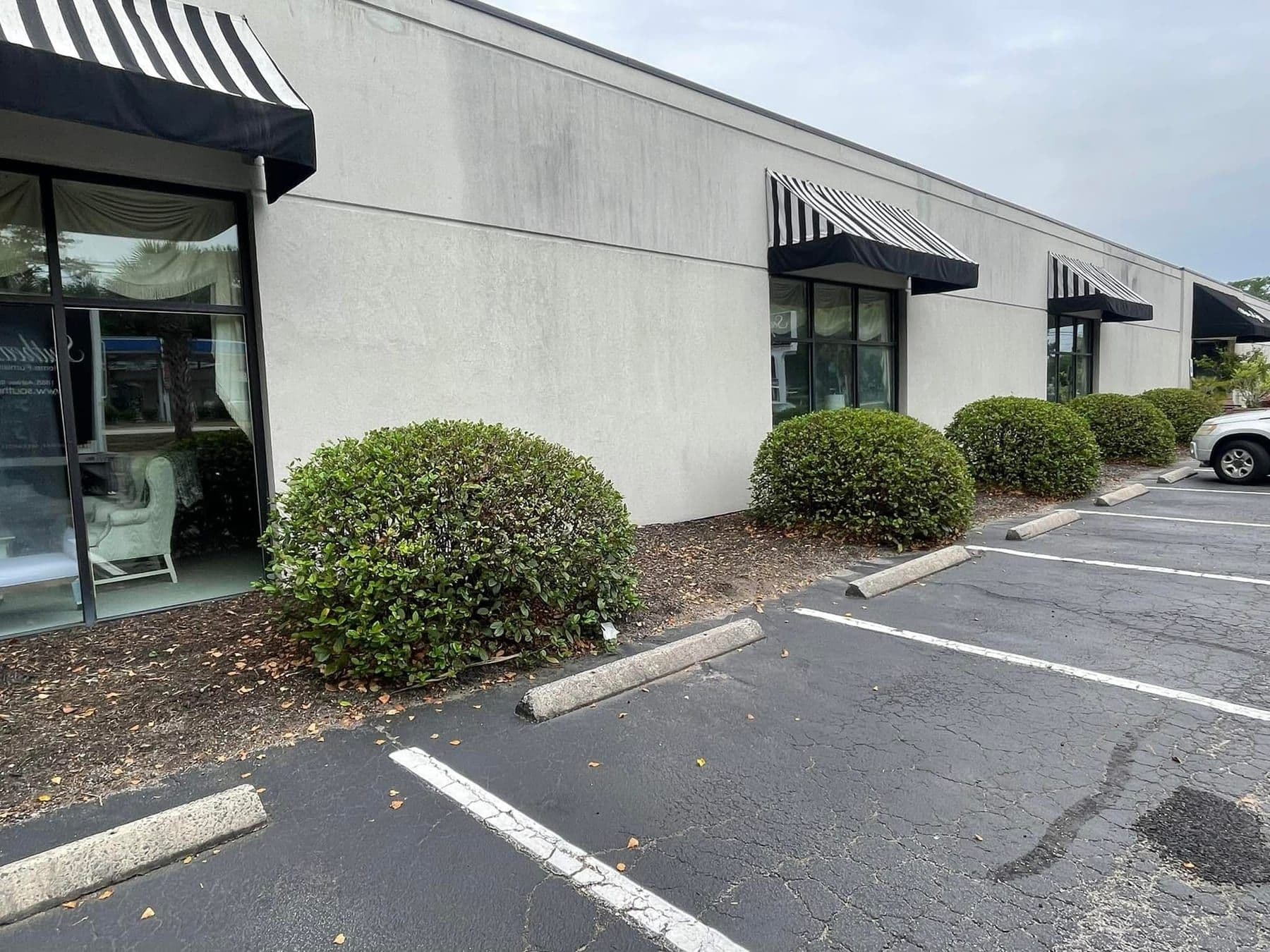
You are holding a bid that says "pressure wash exterior." The number that decides whether that bid cleans your building or damages it is not in the bid. It is in the wall system's own maintenance document, and it is lower than almost anyone expects. Sto caps EIFS at 500 psi and wants the nozzle several feet off the wall. The Brick Industry Association caps pressurized water at 400 psi measured at the nozzle tip unless the brick manufacturer permits more. The concrete masonry body lands at 400 to 600 psi. Every published wall figure I can find sits under 1,000 psi, and most sit at or below 500.
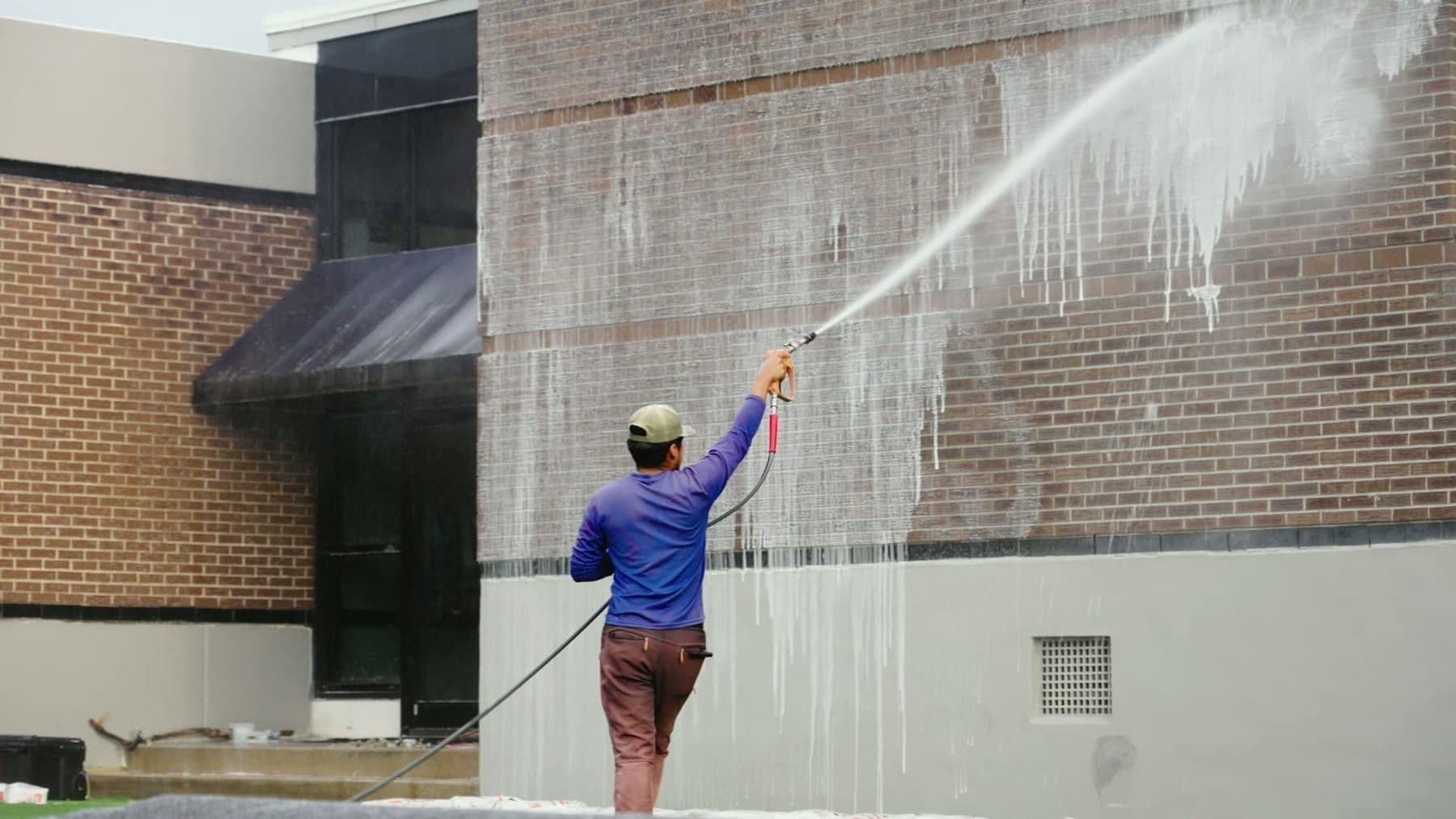
Which means the argument was never pressure versus soft washing. Dryvit prints the answer in its own cleaning bulletin: the chemicals in the cleaner provide the cleaning action, not the force of the water spray used to apply the cleaner. BIA says it the same way, depend on the chemical reaction of the cleaner rather than the scrubbing action of the brush or pressure of the sprayer. A soft wash is that sentence turned into a procedure. Chemistry goes on gently, sits for a stated dwell, then water carries the dead growth and loosened soil off the wall. Below is what pressure actually does to each substrate we see around Charleston, and who eats the cost when it goes wrong.
EIFS is the one that fails most expensively
ASTM E2568 describes PB EIFS plainly: a non-load-bearing wall covering built from insulation board, adhesive or mechanical attachment, glass fiber reinforcing mesh, a base coat, and a textured finish coat. Read that again. Foam board with a thin skin, hung on your building. That standard's scope does not even cover EIFS with drainage, which is a separate category.
Drainage is the whole argument. Joseph Lstiburek of Building Science Corporation argued in a March 2004 research report that EIFS using moisture-sensitive components without a provision for drainage, or in assemblies without adequate drying, is unfit as an exterior cladding. That is his stated position from a litigation-heavy period for the product, not settled industry consensus, so take it as one expert's argument. He carves out hot-dry climates, which he defines as regions receiving less than 20 inches of annual precipitation. The NOAA 1991-2020 normal at Charleston International Airport is 52.51 inches. We are not the exception. Newer EIFS with drainage is a code performance category with a real test behind it: an average minimum drainage efficiency of 90 percent under ASTM E2273.
So what does pressure do to it? Sto's EIFS cleaning procedure says keep pressure at roughly 200 to 500 psi, keep the nozzle several feet from the surface, and do not exceed 500 psi, because the EIFS surface integrity can be destroyed above that. Its "do not" list bars high-pressure washing and sandblasting outright. It also bars steam and other high-temperature methods, because the EPS insulation board in the system has a service temperature limit of about 165 F. Dryvit is stricter on water temperature: rinse water must be cold, since hot or even warm water softens the finish and can remove it.
Application pressure is where crews get it wrong. Dryvit's cleaning bulletin puts cleaning solution on at 30 to 50 psi and warns that high pressure drives the solution through the finish into the base coat, where it becomes a source of future staining. Rinse comes after dwell, normally below 600 psi. Then the sentence every property manager should read twice: Dryvit says cleaning with pressurized water alone usually takes enough force to abrade or remove the finish, and damage from those techniques "can void product performance warranties." Whether your specific warranty is affected is a question for your manufacturer, not for me.
For growth, Sto publishes an actual recipe with a dwell attached: TSP detergent plus household bleach in warm water, soaked 15 to 20 minutes, and it states that without enough dwell the algae or mildew comes back. Two more Dryvit details that belong in a scope: tip angle must match standoff, and for close work you need 45 degrees or wider. Dryvit also says the safest approach keeps both equipment and personnel on the ground, that its finishes can generally be cleaned from the ground, and that leaning a ladder against a wall coated with its finishes can cause damage. That is how we run Commercial Building Washing. Reach comes from the nozzle and the chemistry, not from the wall.
Traditional stucco publishes no psi at all
Portland cement stucco is a different animal. It is cement, not foam with a skin, and the Stucco Manufacturers Association care sheet does not give you a pressure number because it does not assume you brought a pressure washer. It tells you to use a garden hose to direct a stream of water at the wall to loosen dirt, starting at the top and washing the dirt down. A jet nozzle on a garden hose will clean effectively, it says, and do not hold the nozzle too close, because the high pressure stream may erode some finishes. For stains, water-soluble cleaners that will not attack portland cement, lime, or oxide pigment colors.
You will find blog posts quoting a "safe range" for stucco in the low thousands of psi. I cannot find that figure in any manufacturer or trade association document, and every body cited in this post sits an order of magnitude below it. If a bid on a Nexton or Johnnie Dodds property quotes 3,000 psi on stucco, ask which document that came from.
Metal wall panel: you are cleaning a finish warranty
The panel is fine. The coating on it is the asset, and it is thin. Sherwin-Williams publishes a cleaning guide for its fluoropolymer coil and extrusion coatings, the PVDF families on a lot of commercial panel. Plain water with hoses or pressure spray equipment is usually adequate, it says. A 5 percent solution of common commercial non-industrial detergent will not harm the paint. For mildew it prints a mix: one third cup dry powdered laundry detergent, one quart of 5 percent sodium hypochlorite, three quarts water. Dilute one quart of 5 percent into four quarts of finished mix and the strength touching the panel is roughly a quarter of what came out of the jug. That is my arithmetic on their recipe, not a number they publish, and no standards body I could find publishes a hypochlorite percentage for washing walls. No wire brushes or abrasives, and test in an inconspicuous area first. Their warranty clause is blunt: misuse or abuse of those cleaning agents "will result in a voiding of warranty for the surface affected."
The Metal Construction Association's bulletin on composite panels supports semiannual washing, warns against excessive pressure that degrades the finish and against abrasive rubbing, and gives no psi figure at all. It also gives the consequence of deferring the program: the building can end up permanently stained, with the original finish unable to be brought back to its initial appearance. That is the line I would put in a capital plan.
There is a real split in the metal world and I would rather name it than pretend it away. A 2022 operations and maintenance document for Kynar-finished steel cladding says flatly that pressure washing is not recommended on that cladding, because the pressure too often damages the panel. The same document attaches the Sherwin-Williams guide that permits pressure spray. Two documents, one building. We treat the more restrictive one as governing and ask for the operations and maintenance manual before we quote.
Brick and mortar have the tightest published numbers
BIA Technical Note 20 is specific enough to write a scope from. Stainless steel 25 to 50 degree fan tip, held at least 12 inches off the brick. Pre-wet at very low pressure, under 100 psi. Cleaning solution at 30 to 50 psi maximum, because higher pressure forces the solution deep into the masonry where it becomes a source of future staining. Rinse at 100 to 400 psi. Medium pressure, which BIA defines as 400 to 800 psi, only if the brick manufacturer permits it. Above 800 psi is high pressure, and BIA says high-pressure water cleaning is "not appropriate for brick." Excessive pressure, in its words, may damage brick surfaces, erode mortar joints, and remove finishes or coatings. If a stubborn smear is not coming off, BIA says reapplication beats harder scrubbing or more pressure. That is the soft wash argument in a sentence, from a brick body.
NPS Preservation Brief 1 is written for historic buildings but states that its information applies to all masonry buildings, which is why it is worth reading even if your property is a 1998 office building off Sam Rittenberg. It says to start very low, at 100 psi or below, even a garden hose, and progress as needed, "generally no higher than 300-400 psi." Water at too high a pressure is very abrasive and can etch marble, other soft stones, and "some types of brick." Note the qualifier. It also gives a field test anyone can run without equipment: grains of stone or sand in the runoff on the ground means the pressure may be too high.
One thing gets misquoted constantly, so here it is straight. NPS puts mortar joint erosion in its abrasive and mechanical cleaning section, not its water section, and notes joints can be up to 20 percent of a brick wall's surface. BIA is the source that names excessive water pressure as something that can erode joints. Both matter. They are not the same claim.
Precast, tilt-up and painted CMU
The concrete masonry association's cleaning guidance starts from a different worry: driving water into the wall, which causes efflorescence. Keep pressure to a minimum. If high-pressure cleaning is used, limit it to 400 to 600 psi, use a wide flange tip and never a pointed one, keep the tip at least 12 inches off the surface, and direct the spray at 45 degrees to the wall, never perpendicular. It also makes the economic case for agitation: mild brush work improves the result and lets rinsing pressure stay at a minimum.
Painted CMU is where I will admit a gap. I have not found a coatings body publishing a psi ceiling for field-painted block on a strip center, and I am not going to invent one. What we do is run a test panel in a low-visibility spot, start at the bottom of the range, and treat the paint as a coating that pressure strips. Most of the centers and office parks we bid under Property Management Exterior Cleaning are painted CMU with an EIFS band at the parapet, which means two ceilings on one elevation and two different procedures on the same day.
What to put in the scope, whoever you hire
This part works with any contractor, including one who is not us.
Pre-wet from the bottom up, then wash from the top down. SMA says pre-wetting overcomes absorption so dirty wash water is not soaked in. Dryvit says saturating lower elevations prevents clean streaking from runoff. BIA says keep it wet until final rinse.
Cleaning solution applied at 30 to 50 psi. Both BIA and Dryvit hold that line, for the same reason: pressure drives chemical into the wall where it stains later.
Written protection for plantings and soil. Dryvit says cover them or run sprinklers. BIA says it may be necessary to keep solution and runoff off plants and surrounding soil. The GSA historic masonry procedure makes protecting adjacent materials and vegetation a contractor obligation, which is a useful way to write it into a scope.
Benchmarks you can quote back. GSA specifies product application at no more than 100 psi, washing not to exceed 300 psi, and rinsing no higher than 400 psi through a 45 degree fan tip held at least 18 inches off the wall at about 4 gpm. If a bid is 10 times that, ask why.
A temperature clause. Dryvit notes cleaning effectiveness drops when surface and air temperature fall below 50 F. We get those January mornings here.
A runoff and disposal plan. Sto says check local regulatory requirements for disposal of cleaning solution and waste water. NPS says consult the local regulatory agency before a cleaning project involving anything more than plain water washing. Same logic applies to wash water and stormwater rules on a dumpster pad. What your lease requires is a question for your lease, and what the ordinance requires is a call to the municipality.
Worth knowing: GSA's biological growth procedure specifies a quaternary ammonium biocide with at least 24 hours before removal, then soft bristle agitation. It does not call for bleach. Sto's EIFS recipe does. The trade is not unanimous, and anyone telling you there is one industry-standard mix is selling something.
Where our approach costs you more
Soft washing is the more expensive way to clean a wall per square foot. Not in equipment. In chemistry and in time. The crew applies, waits out the dwell, sometimes reapplies rather than raising pressure, and stands there while it works. A crew that blasts the same elevation is off your property by lunch. We lose bids to that crew, and on a substrate with a 500 psi ceiling I still think we are right, because the damage from the fast version does not show up until the next rain. That is the honest trade. You are paying for dwell time you cannot see.
Next step
If you have a building and you are not certain what the wall actually is, take a close photo of a corner and a photo of the parapet, and send them over. EIFS, portland cement stucco and painted CMU look similar from the parking lot and clean nothing alike. We will tell you which one you have and which document governs it, and if the answer is that your building only needs a rinse this year, we will say that.
When you want it priced, request a written scope and a certificate of insurance or call 843-696-4739. We carry $2,000,000 general liability, we provide the COI before work starts, we can name your ownership entity as additional insured when a management company requires it, we use plant-safe surfactants and biodegradable detergents, and if something is not right the crew comes back.