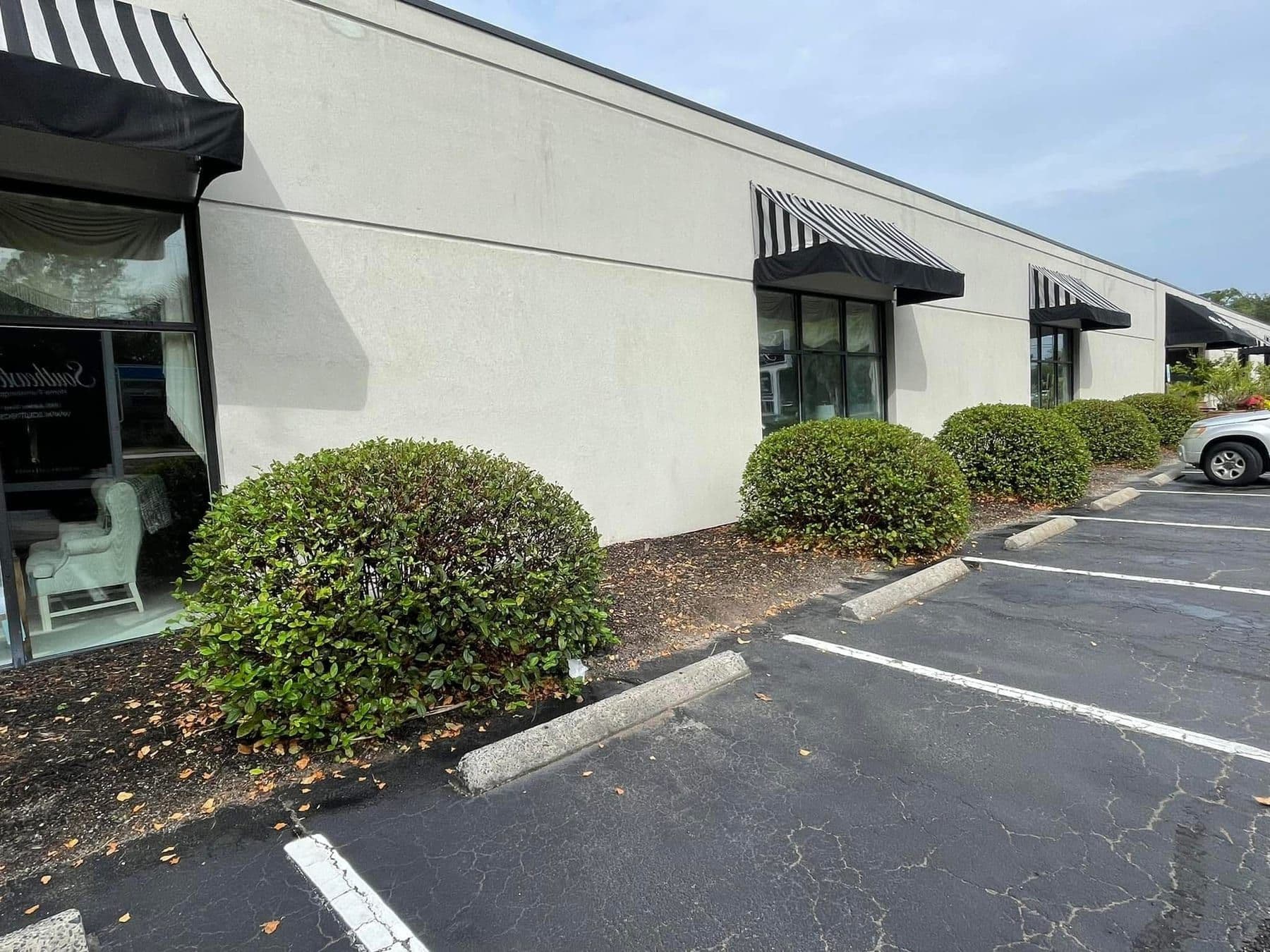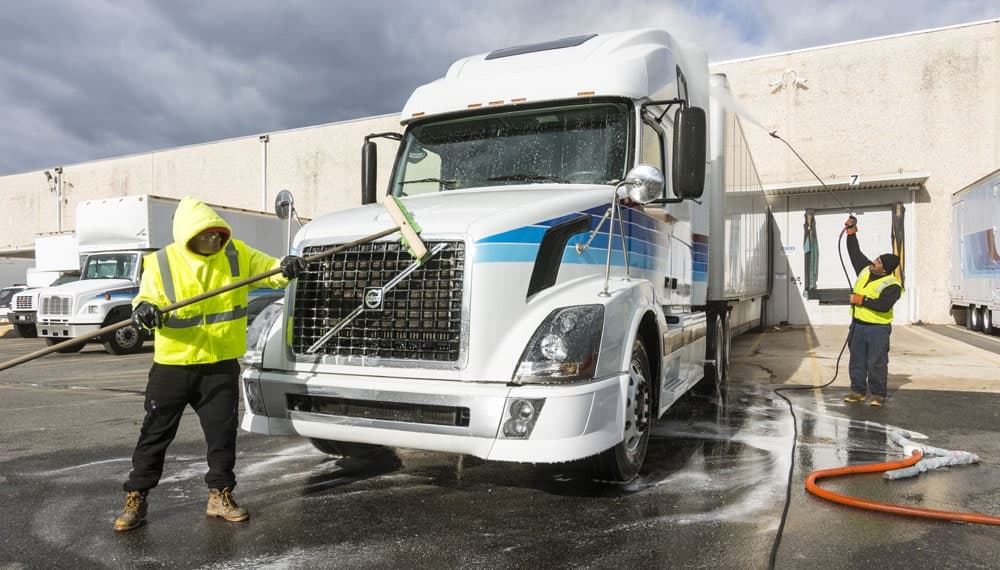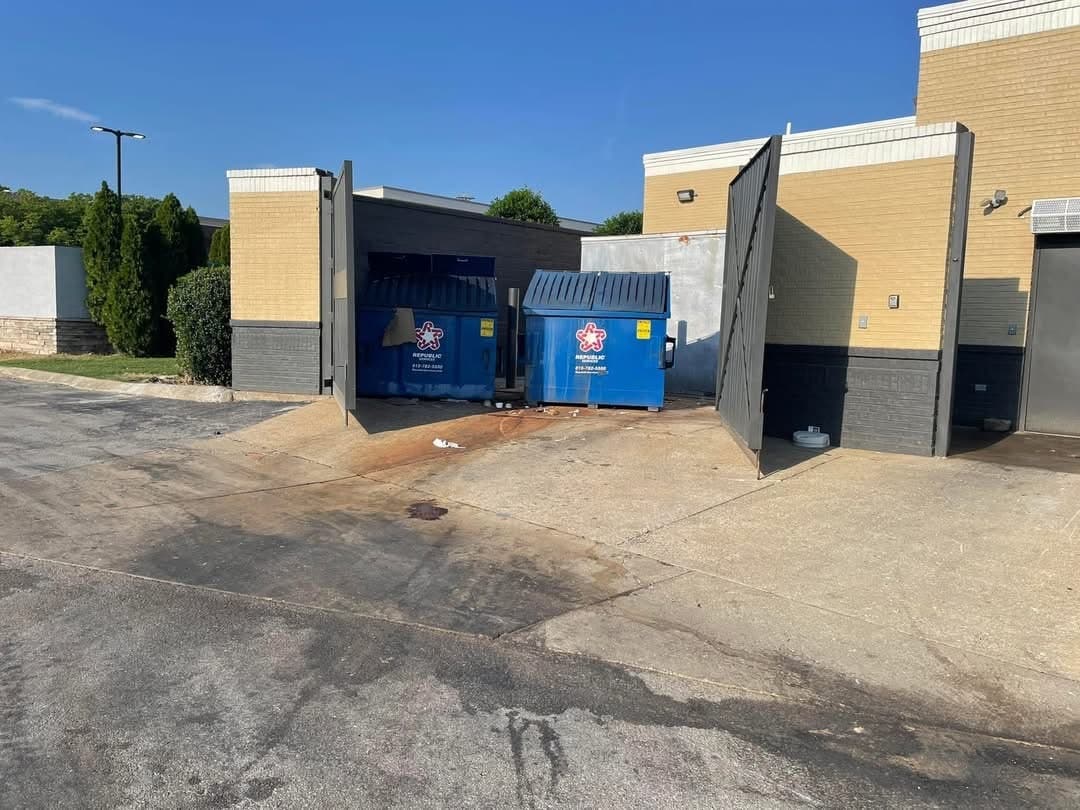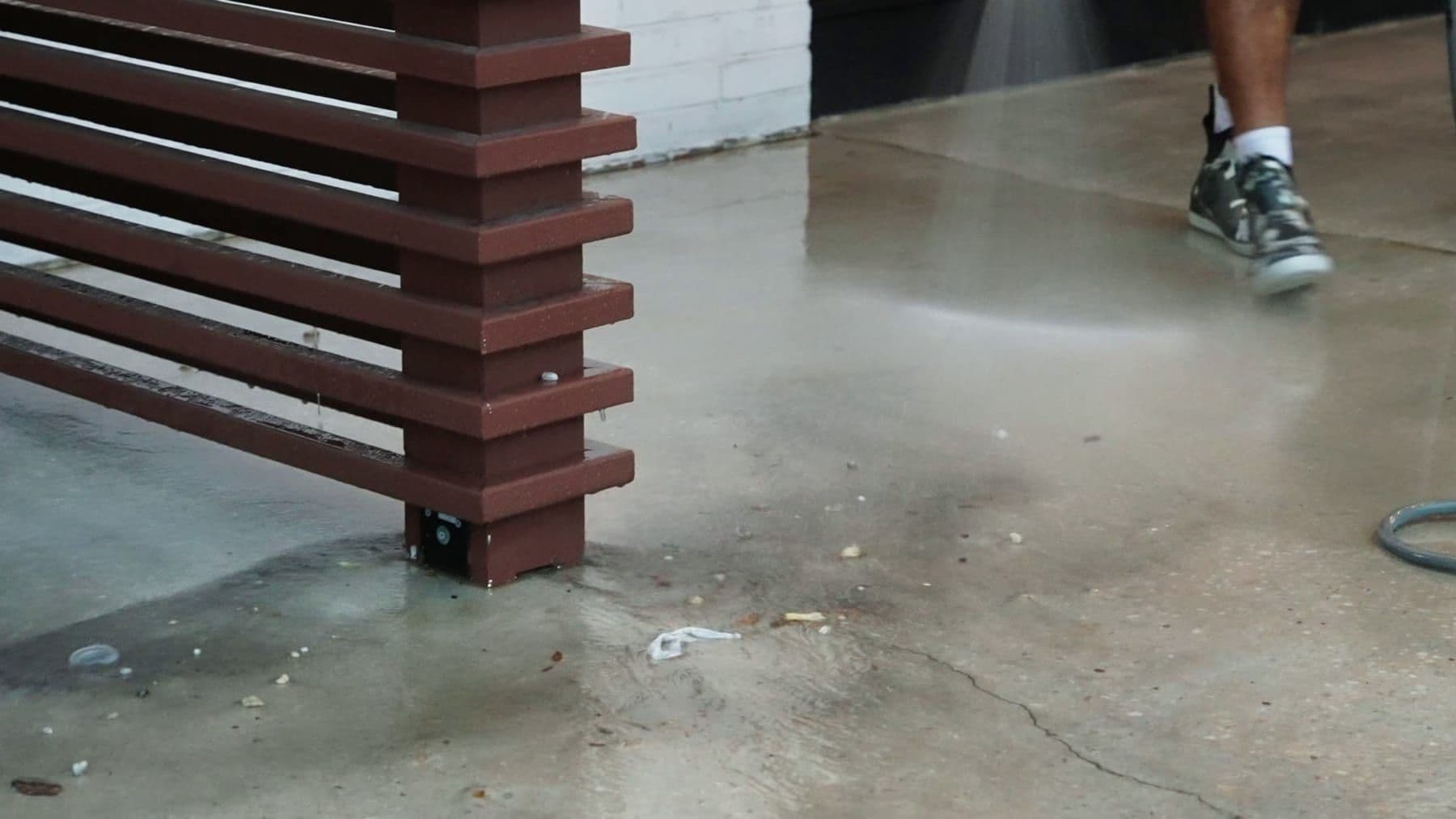
The dumpster pad is the last line item anyone wants to fund and the first thing a tenant emails you about. I get the order of operations. But the part of dumpster pad cleaning in Charleston that should worry a property manager is not the stain on the concrete. It is where the dirty water goes when somebody finally cleans it.
Short version, since you are skimming before a meeting. Grease-loaded wash water is not stormwater. The City of Charleston Stormwater Design Standards Manual defines an illicit discharge as any discharge to the City's stormwater system "not composed entirely of stormwater," and its table of typical illicit discharge sources lists "Building maintenance (power washing)" outright, next to garbage truck washouts. A crew that hoses your corral toward the nearest grate creates a violation the City can pursue against the operator or the owner, and the lien attaches to your parcel either way. Compliant work contains the water, recovers it, and takes it somewhere that agreed to accept it.
One term first. The trade calls recovered wash water "process wastewater." I could not find EPA or SCDES using that phrase for exterior cleaning, so I will use the words the rules use: non-stormwater discharge, and illicit discharge.
Why the pad gets that bad
South Carolina's retail food regulation requires an outdoor refuse storage surface to be nonabsorbent, smooth, durable and sloped to drain. Read that again. The slab is engineered to move liquid off itself, which is fine right up until the liquid is what leaked out of a bin.
Grease is the part utilities lose sleep over. EPA's national pretreatment fact sheet, quoting its 2004 Report to Congress, puts grease at 47 percent of reported sewer blockages, because it solidifies, cuts conveyance capacity and blocks flow. I will not hand you leachate chemistry, because I could not source it. What a crew finds is a film cold water slides over, a smell that returns on the first warm afternoon, and the pest problem the food code names when it requires cleaning often enough to keep refuse areas from "becoming attractants for insects and rodents."
The rule, from Washington down to Chapter 27
Federal
Federal regulation defines an illicit discharge as any discharge to a storm sewer not composed entirely of storm water, and defines storm water as runoff, snow melt runoff, surface runoff and drainage. Wash water is none of those. MS4 permits must effectively prohibit non-storm water discharges by ordinance, and the short federal list of discharges that get a pass covers individual residential car washing and street wash water. Commercial pad and lot washing is not on it.
State
Environmental programs moved to the South Carolina Department of Environmental Services on July 1, 2024 under Act 60, but the teeth are older than the agency. The Pollution Control Act makes it unlawful to discharge organic or inorganic matter into the environment of the State except in compliance with a permit, and its definition of "other wastes" names oil, gasoline and other petroleum products. Civil penalties reach ten thousand dollars per day. The criminal provision runs five hundred to twenty five thousand dollars per day and up to two years, but only for wilful, grossly negligent or reckless conduct, and scare-copy blogs drop that threshold.
Washing your pad does not require a permit. Letting the runoff reach a storm drain is the prohibited part, and the state's small MS4 general permit names wash water as a category MS4s investigate.
City of Charleston
The prohibition lives in Chapter 27 of the City Code. Per the City's Stormwater Management Plan, Section 27-40 prohibits illicit discharges to the City's MS4, and Section 27-53(a) lets the City enter the property, correct the violation, and recover inspection, administration, labor and equipment costs from the owner or operator, or lien the property. That is the sentence to read to your ownership group. The City's own plan lists its enforcement options as administrative remedies, civil penalties, criminal violations and severance of City services, without attaching a per-day dollar figure to any of them. I have not read the penalty text in Chapter 27 myself, so if a salesperson quotes you a daily fine, ask him for the section number.
Cost recovery landing on the owner is why insurance here is not paperwork theater. We carry two million dollars in general liability, send a certificate of insurance before work starts, and name your ownership entity as additional insured when a manager requires it.
Where the water is supposed to go instead
EPA's stormwater BMP guidance is blunt. Avoid direct discharges to storm drain systems. Small job: a bermed wash area, and capture with a wet/dry vacuum for discharge to a sanitary sewer. Larger job: berms plus a vacuum truck. Ask the sewer authority for permission first, because wash water may have special treatment requirements.
Here is where Charleston gets specific, and where most vendors have never looked. I read the Charleston Water System policy manual. It never says wash water, pressure washing or power washing. Not once. CWS regulates by what is in the water, not by what you call the job, and the limits catch pad water anyway. Without prior approval of the Commission it conditionally prohibits wastewater with fats, grease or oils of animal or vegetable origin over 100 mg/l, and it flatly prohibits pH under 6.0 or over 9.0, anything hotter than 140 degrees Fahrenheit, and hauled wastewater except at points CWS designates.
CWS's pretreatment FAQ points waste-discharge questions to iwpp@charlestoncpw.com. A separate document governs the hauling side: the Category Waste Policy sets the procedure for a hauler bringing liquid waste to the Plum Island plant, and Plum Island staff verify the hauler is on the approved list before anything gets offloaded. I will not promise you CWS takes pad water. They publish no wash-water route. The contractor asks first, in writing, and you keep the answer.
The containment sequence, step by step
Steal this whether you hire anybody or not. South Carolina has a municipal guide written for power washers, from Columbia rather than Charleston, and its dumpster section is the clearest published sequence in this state.
Find every storm drain first, including the one behind the corral nobody thinks about.
Read the grade. High spots, low spots. Water goes where the slab tells it.
Block the drains in the path: storm drain mats, flexible berms, inflatable drain plugs.
Dry cleanup before water. Sweep, absorbent on the oily spots, sweepings and used absorbent to the trash.
Wash with water and soap, then contain and collect with a wet vacuum, sump pump or vacuum pump.
Filter it if it is heavily loaded with dirt, grime or food particles.
Run it through an oil/water separator or grease interceptor if it is oily or greasy.
Pre-treat before sewer disposal. Columbia's thresholds: cool below 150 degrees, pH between 6 and 9, fats, oils and grease under 100 ppm. Those are Columbia's numbers; CWS caps temperature at 140, so use the tighter figure here rather than merging the two into one imaginary rule set.
Get approval before disposal. Columbia requires it from its Wastewater Compliance Section. Here you are asking CWS.
Never open a sanitary sewer manhole. Columbia says it plainly: unsafe and illegal.
That guide also kills the two excuses I hear most. Any pollutant left on the pavement gets carried to a storm drain or stream by the next rain, so "it will dry" is not a plan, and wash water carrying soap or cleaning products cannot be left on paved surfaces at all.
The food regulation names the method. SC Regulation 61-25 requires implements such as high pressure pumps, hot water, steam and detergent for effective cleaning of refuse receptacles, and permits approved off-premises-based cleaning services when a site does not keep them on hand. Hot water and a degreaser are in the regulation, not invented to pad an invoice. We use plant-safe surfactants and biodegradable detergents, matching EPA's advice to use phosphate-free biodegradable soap where detergents are necessary. That sequence is what our Dumpster Pad & Corral Cleaning scope is built around, whether it is commercial dumpster corral cleaning at a shopping center or one kitchen's back door.
How often? Nobody published a number
Every "weekly for restaurants, monthly for retail" chart online is a pressure washing company's marketing. I went looking for a regulatory interval. There is not one.
What exists is a performance standard. Reg 61-25 requires soiled receptacles to be cleaned at a frequency necessary to prevent buildup of soil or attracting insects and rodents, and physical facilities cleaned as often as necessary to keep them clean. That puts the judgment on your waste stream and your volume. A kitchen near Shem Creek dumping wet organics into an open bin runs a different cycle than an office building on the Upper Peninsula throwing out cardboard. I ask what goes in the container and how often it gets pulled, then adjust after two visits. The same regulation backs after-hours work, since cleaning should happen when the least food is exposed.
What an inspector or a landlord actually looks at
A naming correction first, because half the internet has this wrong. DHEC does not exist anymore. In the July 2024 restructuring the retail food program went to the South Carolina Department of Agriculture, which now inspects roughly 24,000 retail food establishments statewide under Regulation 61-25.
The outdoor refuse area sits inside that inspection: surface nonabsorbent and sloped to drain, enclosure durable and cleanable, tight-fitting lids, a compactor set so rodent harborage is minimized and cleaning under it is possible, drain plugs in place, the area clean and free of unnecessary items. I have not verified how Charleston County scores a pad, so I will not tell you what it costs you. Those sections exist, and anyone in your corral with a clipboard can quote them.
Then the bridge almost nobody notices. That same part of the regulation sends waste water from the cleaning to 5-402.13, a Priority item requiring sewage to be conveyed to disposal through an approved system operated according to law. The food code hands you back to the wastewater rules. Restaurant tenants feel this first, which is why our Restaurant Exterior Cleaning work usually starts at the corral, and why restaurant dumpster pad cleaning gets scheduled around service instead of around our convenience.
Refuse area maintenance usually lands on the tenant or gets folded into CAM, and those two versions produce very different arguments when a pad gets cited. I am not a lawyer, so read your actual lease, and call the municipality on ordinance questions.
The trade-off I will own
Containment costs more and takes longer. A contained wash runs well past an open-hose pass, we may stage a recovery tank on site, and if the sewer route is not settled we recover and haul, which is another line on your invoice. On a pad that was not badly loaded to begin with, the finished concrete can look about the same as what a cheaper crew leaves that afternoon. What the money buys is the absence of a discharge on your property and a paper trail you can hand a landlord. If something is not right when we leave, our crew comes back.
Outside the City limits, assume nothing
North Charleston is its own regulated MS4 with its own ordinance. I could not get a working link to their current illicit discharge section, so I am not citing a number I cannot verify; call the City's Public Works stormwater staff before scheduling work in Park Circle or Northwoods. Mount Pleasant, Summerville, Goose Creek, Daniel Island, James Island and West Ashley are not one rule set either, and the sewer side splits the same way. Charleston Water System does not serve all of Greater Charleston; North Charleston Sewer District and James Island PSD have their own answers. Grease on a concrete pad is the same problem everywhere. The disposal answer is not.
What I would do this week
Walk your pad and ask one question: if we washed this today, where would the water end up? If the answer is a grate, send us what is on the pad and where it drains or call 843-696-4739, and we will scope the containment and tell you whether this is something your own crew can handle in house.