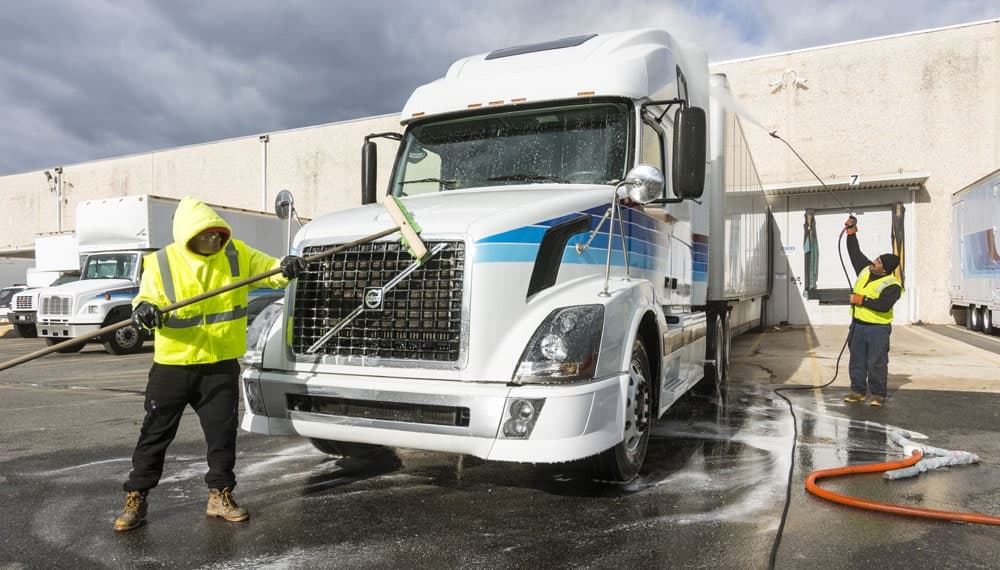
Two questions come up every time I walk a yard between the port terminals and Summerville. How often does the fleet actually need washing, and does it do anything besides make the trucks look decent in a customer's lot? For most Charleston fleets I run a two-week cycle, weekly on anything hauling waste or loading outdoors all day, and the rinse that earns its keep is the one underneath the truck. The door panel is the part you look at. The frame rail is the part that fails.
Now the part most contractors skip. There is no published wash-frequency standard for commercial vehicles in coastal air. Not from AMPP, not from FMCSA, not from any OEM I could find. The real data comes from northern DOT fleets fighting road salt, a different delivery route with the same chemistry. So when I hand you a cycle, know what it is: my operating practice, not a standard I can point at.
What chloride is doing between washes
Aluminum survives on a passive oxide film thinner than anything you can see, and it holds until halide ions get to it. NIST, working with Naval Air Systems Command, calls the chloride ion one of the more aggressive of these ions for aluminum alloys, tied to pitting, crevice corrosion and stress corrosion cracking. That is your box, your ladder rack, your tank straps.
How much chloride sits in the air over Charleston? Nobody has published a number. Not the peninsula, not the terminals, not the Ravenel. I looked. The best measured coastal data anywhere is NASA's, from its Florida test sites. NASA recorded 982 mg of chloride per square meter per day at 45 meters from the Atlantic and 70.6 at 183 meters, with carbon steel corroding at 0.295 mm per year beachside against 0.014 to 0.026 inland. From roughly 200 meters out to five miles, the rates were statistically indistinguishable.
That cuts against the easy pitch. A yard in Northwoods is not sitting in the same air as a slip at the end of the Upper Peninsula. For most fleets the yard is not the variable anyway. The truck is.
Why the underbody matters more than the sides
Salt on a flat painted panel is a slow cosmetic problem. Salt packed into a seam is a different animal. A Clear Roads study prepared for Minnesota DOT puts it plainly: crevice and poultice corrosion happen where dirt and moisture get trapped, between pieces of metal, under gaskets, at fasteners, and aluminum gets worse, not better, once it is bolted to steel. Its washing guidance is worth taping to the wall: frame rails, brake components, the underside of the chassis.
Brake lines are not hypothetical. NHTSA's investigation into corroded brake pipes on 1999 to 2003 GM pickups and SUVs sold in salt states logged 3,645 complaints, 107 alleging crashes and 40 injuries before closing in 2015 without finding a defect. That is road salt on northern equipment, not marine air. The exposure route differs, the chloride does not.
Electrical is where it gets expensive, because corrosion rarely gets written up as corrosion. It shows up as an intermittent trailer light or a code that clears itself. Clear Roads recommends non-sodium dielectric grease on plugs, sockets and battery terminals, and cleaning connectors every six months with water, not soap, and a wire brush. Your techs can do that. It is not our work and I will not pretend otherwise.
How often, by what you run
The one published benchmark I trust is a survey of 37 state DOT winter maintenance staff, where more than half wash trucks after each event and only four wash daily or after every shift. Those are agencies with wash racks on site, and their schedules still slip. Here is how I set frequency on a fleet washing program in Charleston, offered as our practice and nothing more:
Box trucks and straight trucks on regional routes: every two weeks, undercarriage every visit.
Service vans and light pickups working King Street addresses: every two weeks, mostly for appearance. A van parked outside a client's storefront is doing brand work whether you meant it to or not.
Refuse packers and anything with a compaction body: weekly at minimum. Organic load, chloride, and tailgate seals that never dry out is the worst combination in this trade.
Trailers and drop equipment that sit for weeks: on the cycle, not off it. Sitting wet with salt on it is worse than driving.
On painted sides we run a two-step, a low-pH pre-soak followed by a high-pH wash, with plant-safe surfactants and biodegradable detergents because most yards have landscaping and a swale somewhere downhill. I will not claim two-step beats brushing. Every source I can find making that comparison sells two-step chemicals.
The argument I have with my own equipment
Here is the honest limit of what we do. The best public guidance on pulling salt off an underbody says not to use a pressure washer, because water gets forced into places it cannot escape from and corrodes them. Clear Roads recommends low pressure and high flow, on the order of 300 psi at 300 gpm, physical action alongside washing, and salt neutralizers, whose performance is alloy specific.
I own a pressure washing company and I think that guidance is right. So we drop pressure and raise volume under the truck, keep tight nozzle work for hard surfaces, and stay off seals and looms with anything aggressive. If a fleet wants the underbody blasted at full pressure because it looks more thorough, we decline. That costs us jobs occasionally.
Washing on the yard beats sending drivers out
Send a truck to a wash bay and you pay for the drive out, the wait, the drive back and the out-of-route miles, at driver wage, in hours the truck should be producing. I cannot give you a dollar figure on that, because nobody has published one worth citing. You know your loaded cost per hour.
We work yards overnight and pre-shift so nothing leaves the property. A certificate of insurance goes over before the first visit, we carry $2,000,000 in general liability, and we can name your entity additional insured when a lease requires it. Yard work usually pairs with the building and the lot, which is how most of our industrial and warehouse cleaning accounts started.
Where the wash water goes
Worth understanding even if you never hire anybody. Under federal rule, regulated small municipal storm sewer permittees must effectively prohibit non-stormwater discharges into the storm sewer system. The categories they only address if those turn out to be significant polluters are a closed list, and that list names individual residential car washing. Commercial fleet wash water is not on it. South Carolina mirrors the federal list in its small MS4 general permit, where item (o) of nineteen authorized categories is residential car washing and commercial vehicle washing appears nowhere. EPA names fleet management activities as a main stormwater impact from vehicle washing, and storm drains run to waterways, not to treatment.
The prohibition itself, and its penalties, live in your municipality's ordinance, and your lease may push compliance onto you as the tenant. Read the lease, then call the municipality. I run crews, not a law office.
Washington State's Department of Ecology publishes the clearest spec I have found for mobile washing. Wrong state, right practice. Washwater must be collected and sent to a wastewater system, recycled in a closed loop, or hauled to treatment. Wash on an impervious surface extending four feet past the vehicle on all sides, use a portable pad or vacuum recovery unit on porous ground, and plug any storm drain in the wash area and pump the pooled water off. Hold any fleet washer to that, us included.
The DOT reasons to wash that have nothing to do with rust
Dirt is written into the federal rule. 49 CFR 393.9(b) says required lamps and reflective devices must not be obscured by the tailboard, the load, its covering, by dirt, or anything else. FMCSA's safety planner lists not having required operable lamps among the most common parts and accessories violations cited roadside, though it publishes no rank order, so I will not tell you it is number one. Your USDOT number carries a duty most people miss too: 49 CFR 390.21 requires the marking readily legible in daylight from 50 feet while stationary, and maintained so it stays that way.
One South Carolina correction, because I had it wrong and repeated it. SC does not require a truck plate to be kept free of dirt. The "free from foreign materials" language in 56-3-1240 sits in subsection (C), covering motorcycles. The code does require the plate open to view and fastened securely, front-mounted on truck tractors, plus a lamp rendering the rear plate clearly legible from fifty feet to the rear whenever the headlamps are lit. A plate lamp caked in film works against that.
Where I would start
Put two trucks on ramps, one that runs the peninsula daily and one that mostly stays inland, and see whether the frame rails tell the same story. If they do not, you have your answer on frequency, and you can get a quote or call 843-696-4739 to talk through a route that fits your dispatch window.