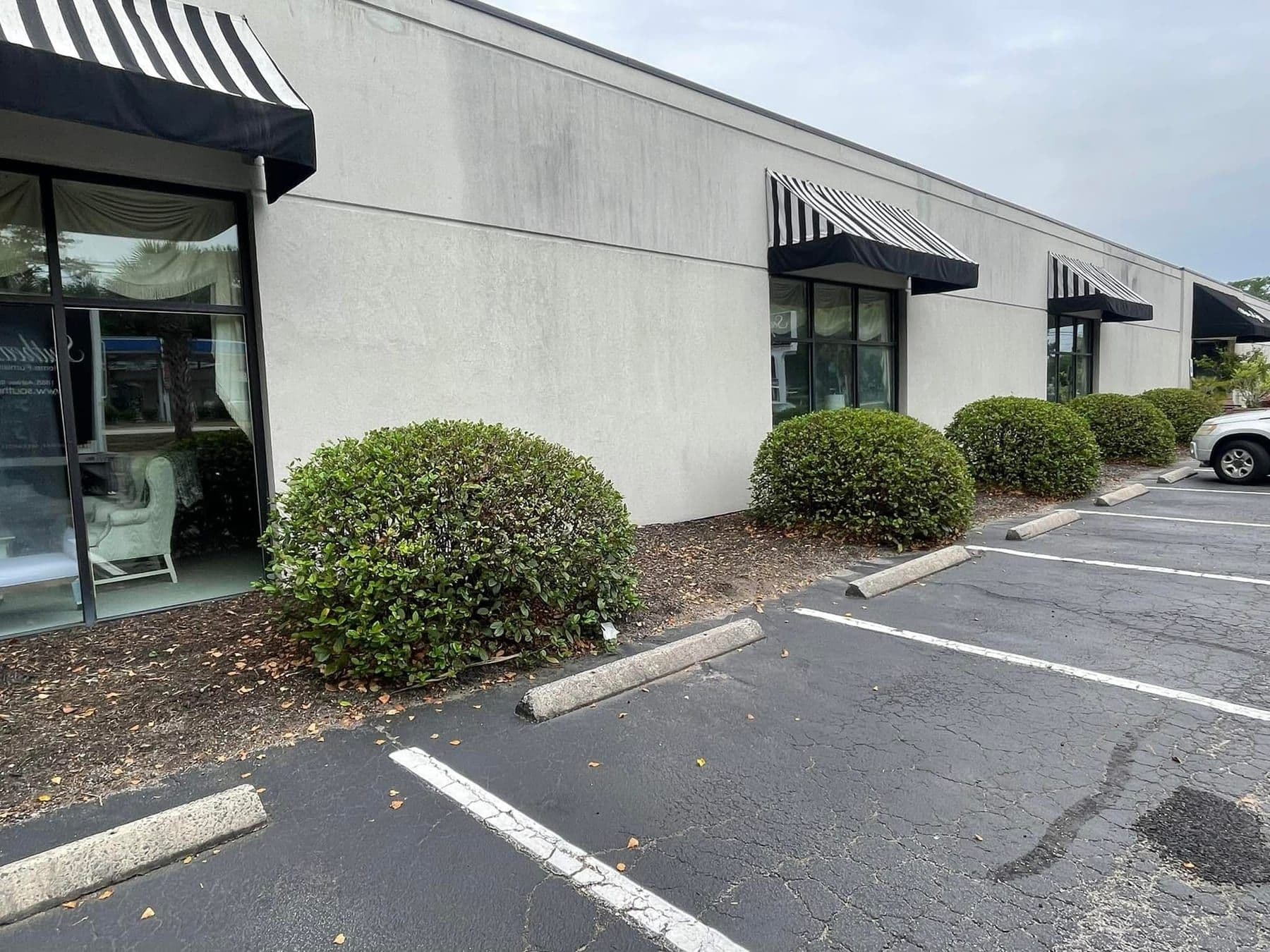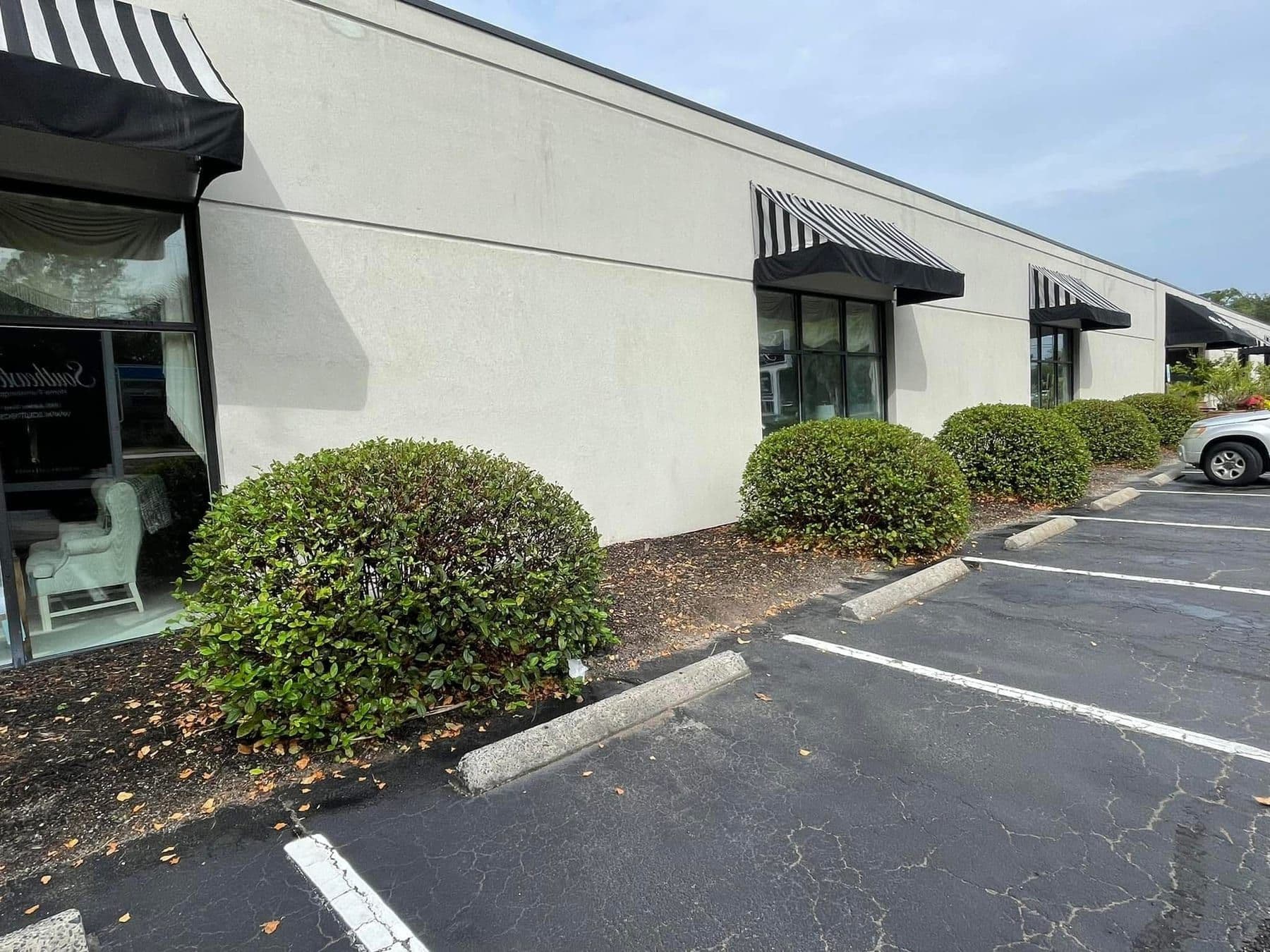
You have a strip center on Rivers Avenue. Restaurant on one end, nail salon in the middle, an end cap you are still trying to lease. Somebody just handed you a proposal for quarterly exterior cleaning on a three year term, and your gut says you are being sold a subscription.
Short answer, because you have a day to run. A scheduled program earns its keep when the property makes its own dirt whether you look at it or not: a food tenant, a dumpster corral, a drive through lane, heavy foot traffic, live oaks over the parking. Miss all of those and call somebody when it looks bad. I run crews and I still talk people out of programs.
What a scheduled program actually buys
Four things. A cleaner building is not one of them, because a single visit gets you that.
Mobilization gets spread out. Getting a truck, a buffer tank, hose, containment and a crew onto your property costs money before the first trigger is pulled. On a one off that rides on a single visit. On a program it rides across the year. No percentage from me; nobody has published one I would repeat.
Each visit is lighter. Growth that never establishes comes off faster than growth that has sat on a shaded north elevation since March. The National Park Service, guiding the cleaning of historic masonry buildings, says biological growth "has traditionally been kept at bay through regularly-scheduled cleaning as part of a maintenance plan." That is masonry, not your 2006 EIFS shopping center. Take the principle, leave the specification.
No rush premium. A regional director announces a walk with ten days' notice, and you are either on the schedule already or buying somebody's Saturday.
The decision disappears. A recurring line item gets defended once at budget instead of relitigated four times a year.
Where I would tell you to skip the contract
I mean that literally. These are the sites where we quote one visit and say call us next spring.
A small professional or medical office. No food tenant, light foot traffic, open exposure, thin tree cover. One wash ahead of your busy season is the whole program.
A property under contract or heading to market. Clean it once so it photographs honestly, and let the next owner set a schedule.
A single tenant building where the tenant maintains its own frontage under the lease. Read the lease first. I have watched a landlord and a tenant each pay for half a sidewalk.
A building due for repaint or resealing in a few months. That wash belongs to the paint job. The USDA's handbook on wood exteriors is blunt that mildew "must be killed before repainting, or it will grow through the new paint coat". Written about wood, but it tells you why sequence beats frequency there.
A warehouse where the only concrete is a rear apron nobody sees and no inspection covers.
The Department of Energy is not on that side of the argument. Its maintenance guide calls reactive maintenance "run it till it breaks" and spends the chapter pushing the other way. It still prints two honest advantages of the approach, the two you already thought of: "Low cost" and "Less staff." It lists disadvantages too, and they run to unplanned downtime, overtime labor and secondary damage. Read that in scope. DOE means equipment maintenance, not how your sidewalk looks on a Tuesday.
The two Charleston variables that decide it
NOAA's state climate summary notes that South Carolina's "geographic position at subtropical latitudes and adjacent to the Atlantic Ocean gives it a humid climate." No shock to anyone who has crossed a parking lot here in August. The asphalt roofing manufacturers say algae discoloration is most widespread in the Gulf States and along the Northwest and Eastern Seaboards, and occurs in all regions of the country, "especially those subjected to warm, humid conditions."
The region is a given. Your site is not. The USDA handbook found mildew "most commonly found on walls behind trees or shrubs where air movement is restricted." Air movement and sun are what I read on a walk, more than square footage. A north facing dumpster enclosure under live oaks off Sam Rittenberg behaves nothing like a west facing metal building in Nexton with two hundred feet of open lot on that side. Same county. Different answers.
And it comes back. Nobody has published an interval I would repeat, and I will not put one in writing either. Our own field observation across Charleston, Mount Pleasant and North Charleston: shaded elevations and dumpster corrals return first, sun hit and wind exposed surfaces hold longest. No figure attached to that. It is what the crews see.
What goes in the agreement so it is not a trap
Useful whether you hire us or the outfit down the road. I am not a lawyer and this is not legal advice, so have whoever reviews your contracts read it. If the real question is your lease, the lease answers it.
Term
One year. I would not sign a three year exterior cleaning agreement with anybody, us included, unless the concession is real and the exit is real. A year is long enough for both sides to learn the site.
Out clause
Thirty days written notice for convenience, either party, no penalty. Ask plainly. A contractor who refuses is telling you what he thinks of his own retention. The fair middle is a cure period: documented failure, a defined window to fix it, termination if it is not fixed.
Escalation
"Price subject to change" is not a mechanism. Either the price is fixed for the term, or one adjustment a year capped at a stated percentage, or it moves with a published index named in the document. Put fuel and water surcharges in that same paragraph, because that is where a flat price stops being flat.
Scope
Write down what a visit covers by surface and by area, and the method for each. Soft wash under 500 PSI on painted metal, EIFS and stucco. A surface cleaner at 4 to 8 GPM on flatwork. Hot water near 180 degrees on a dumpster pad, because grease does not care much about pressure; it responds to heat and dwell time. Then settle what happens when scope changes, because it will. A new food tenant in that end cap changes the pad forever. Change order, renewal re-price, or included?
Two more get skipped. Water source: confirm a spigot with usable flow and write down what happens if there is not, because hauling water is a line item, not a surprise. Wash water: agree who owns containment and where the runoff goes before the first visit.
Then insurance. Require a certificate of insurance before the first visit, and if you manage the property for an owner, put additional insured status in the document instead of chasing it later. We carry two million in general liability, send the COI before the crew rolls, and name the client additional insured when a manager requires it. That paperwork is most of the job on a portfolio, which is why our Property Management Exterior Cleaning work is built around it. Once proposals are in hand, how to compare commercial pressure washing bids is the harder problem.
The number you will see misused
Somebody will hand you a proposal quoting the Department of Energy's finding that preventive maintenance delivers an "Estimated 12% to 18% cost savings over reactive maintenance program." Real figure, federal source. It is also about equipment and building systems reaching design life: belts, bearings, lubrication, rotating equipment. Not exterior cleaning. Not appearance. Nobody has published that number for washing a building.
Two things do exist. BOMA International publishes a guide to exterior maintenance management, framed around avoiding "the time, inconvenience, and extra expense of repairing or replacing roofs, windows, lighting, and other systems prematurely." Guidance, not a standard. IFMA's benchmarking report covers janitorial, maintenance and utilities across nearly 40,000 facilities, segmented by US climate zone. It does not break out exterior cleaning, so do not let anyone tell you it does.
Where our program falls short
The honest limitation of what we sell: a schedule keeps a surface from getting worse, but it does not make an old surface new. On concrete that is spalled, oil saturated over years, or carrying rust and battery acid that already migrated into the aggregate, we will pull the surface stain and a shadow will still be there when we pack up. Our re-do guarantee means the crew comes back when the work is not right. It does not mean we can undo a decade.
What I would do next
Walk your property with your phone. North elevations first, then the dumpster corral, then anywhere water stands after a rain. Take the same shots in three months and compare. That is your data, and it costs nothing.
If you want a second read, we will walk it and say straight out whether a program makes sense or whether once a year is plenty. Request a Quote or call 843-696-4739. If the answer is that you do not need a contract, that is the answer you get.