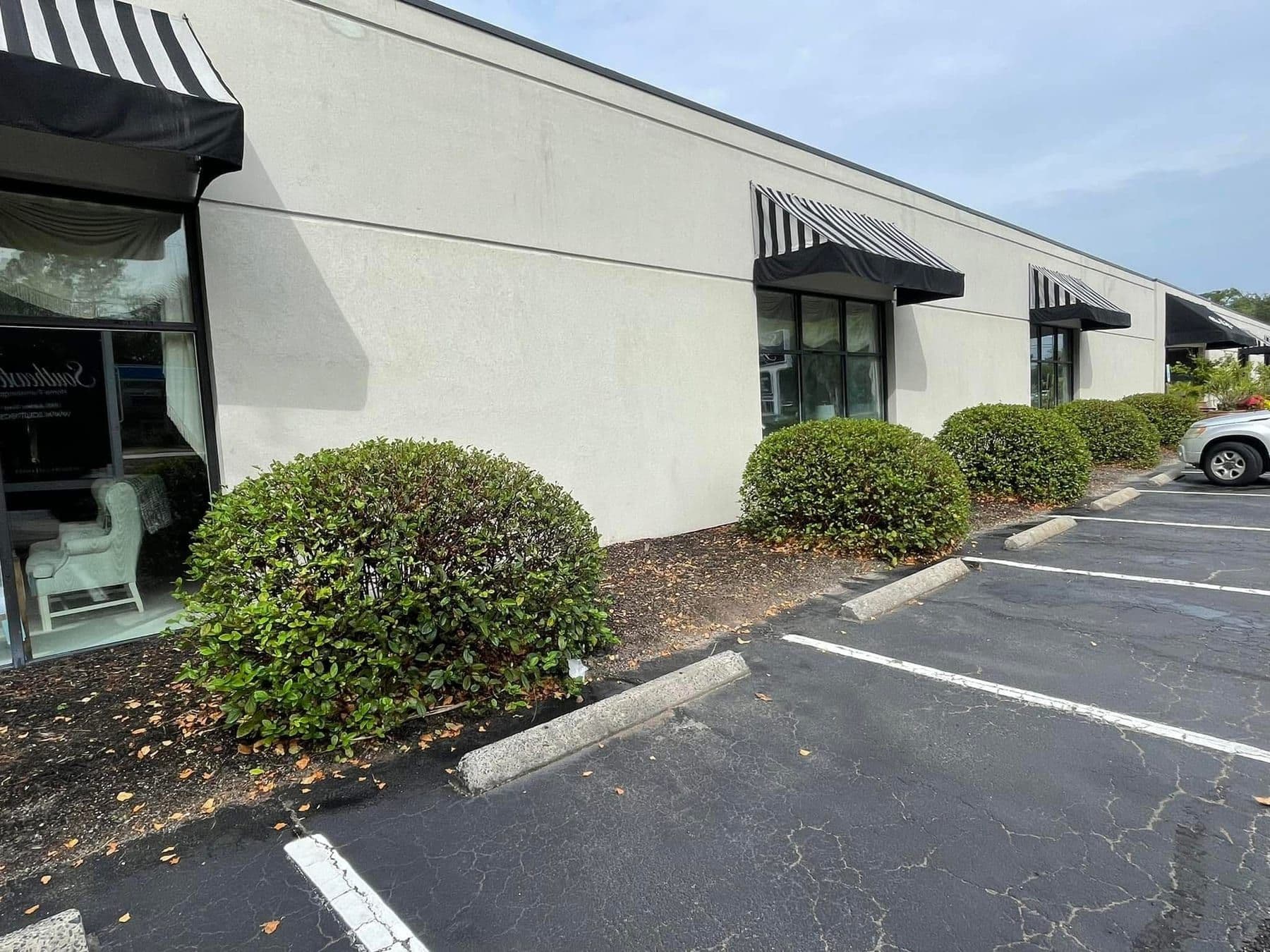
The thing that costs you money on an occupied property is not a streaky sidewalk. It is somebody going down on a wet walkway my crew left unmarked, or detergent mist getting pulled into a rooftop air intake above a suite full of tenants. I plan for those two before I plan the cleaning.
So here is the answer up front. On an occupied commercial site, safe means the crew takes wet surfaces out of service and marks them, pedestrians get a route that never crosses the work, chemicals are controlled where they are applied instead of where they get complained about, and the paperwork exists before anybody pulls a trigger. We carry $2,000,000 in general liability and send a certificate of insurance before work starts. That certificate matters less than you probably think. It is evidence that somebody bought a policy, and the form itself says it gives you nothing.
OSHA never wrote a pressure washing rule
Search for OSHA pressure washing regulations and you will find contractor blogs implying a dedicated standard exists. It does not. OSHA's index of Part 1910 lists 475 sections and not one of them contains the word wash. The nearest titles cover spray finishing with flammable materials, respirator cleaning procedures, and fixed water spray extinguishing systems. None of that is about cleaning your building.
What applies is a set of general rules, plus the General Duty Clause. Section 5(a)(1) of the OSH Act requires an employer to furnish each of his employees a place of employment "free from recognized hazards that are causing or are likely to cause death or serious physical harm to his employees." Read both limits in that sentence. The duty runs to his employees. In South Carolina these rules are enforced by SC OSHA inside the Department of Labor, Licensing and Regulation, which has identically adopted the federal standards for private sector work.
That gap should shape how you read any contractor's safety pitch. Nearly everything OSHA says about wet surfaces protects my people, not your tenants. The one exception is the sign standard.
What a crew should actually do with a wet walkway
29 CFR 1910.145 is the safety sign standard, and it is the one rule here that expressly names members of the public who may be exposed to hazards. It also fixes the format. Caution signs are for potential hazards, and the standard color is a yellow background with a black panel and yellow letters. Danger signs are red, black and white, and they are for immediate danger. A wet sidewalk is a caution sign. If a crew is planting red danger signs at a storefront entry, they either do not know the standard or they are performing safety rather than doing it.
The cordon rule is in 29 CFR 1910.22, which is titled "General requirements" and sits inside Subpart D, Walking-Working Surfaces. Plenty of blogs get that backwards. Paragraph (a)(3) lists spills among the hazards a walking surface has to be kept free of. Paragraph (d)(2) is the one I actually run the job by: if a hazardous condition cannot be corrected immediately, it "must be guarded to prevent employees from using the walking-working surface until the hazard is corrected or repaired." One honest caveat, since I see this misused constantly. The drainage and dry standing places language in (a)(2) applies to the floor of a workroom. It does not reach your plaza, your sidewalk or your parking deck, and anyone quoting it at you about a storefront is stretching it.
Here is what that looks like on the ground, and this part is worth stealing whether or not you ever hire us. Cordon the whole wet zone, not the working end of it, because water runs. Cone and tape a perimeter that includes the downhill runout. Set caution signage at every point a person could enter that zone, including the door nobody uses. Keep the barrier up until the surface is walkable, not until the machine is loaded. Hard surfaces stay slick after the sheen is gone, so somebody has to walk it and decide. On a slope, block the bottom first. And put one person on people, not on a wand, whenever the site is open.
Routing people, not just water
Sequencing is most of the safety plan. On King Street sidewalk work I want the hours after close and before the first deliveries, with a hard finish so the surface has time to dry before foot traffic. A hotel porte cochere gets split down the middle so one lane stays open. A Coleman Boulevard shopping center gets phased entrance by entrance, never both doors of a tenant at once. Most of our exterior cleaning for property management companies is scheduled around tenant hours first and crew convenience second, because the alternative is a claim.
Tell your contractor about the things they cannot see from the parking lot. Dialysis patients, an early daycare drop-off, a delivery window, a tenant with a legal obligation to keep an accessible route open. We cannot route around what nobody mentions in the walkthrough.
Chemicals, intakes and where the water ends up
The chemical risk on a shared site is real and it is boring in the way real risks usually are. Soft washing commonly uses sodium hypochlorite. Rust and battery acid stain work uses acidic products. Those two never meet, because as an older archived CDC MMWR report documents, when sodium hypochlorite and an acid are mixed, chlorine gas and water are released, with effects that have included eye, nose and throat irritation, dizziness, cough and chest pain. Separate products, separate tanks, separate days if two trades are on site.
Air intakes get identified before anything is mixed. We walk them with building engineering, coordinate a shutdown or a recirculation window where the equipment allows it, and work away from them. I am not going to quote you a standoff distance, because I have not verified a number worth repeating. Landscaping gets pre-wet and rinsed, and we use plant-safe surfactants and biodegradable detergents, which reduces the risk without eliminating the need to rinse.
Two paperwork items apply to any contractor bringing chemicals onto your property. 29 CFR 1910.1200 requires a written hazard communication program with a list of the hazardous chemicals present, and paragraph (e)(2) specifically requires a contractor whose chemicals may expose another employer's employees to spell out how those employers get access to safety data sheets and precautionary information. Under paragraph (g)(9), a crew whose people travel between sites can keep the safety data sheets at its primary facility, as long as employees can immediately obtain the information in an emergency, and electronic access counts. The written program is a separate item: (e)(1) says maintain it at each workplace. Ask how. Second, if a product carries a mildewcide or other antimicrobial claim, EPA treats it as a pesticide and the label is binding: it is a violation of federal law to use it inconsistently with its labeling. That is not true of every product in the truck. A plain surfactant with no antimicrobial claim is not a pesticide.
Where the rinse water goes is a separate question with local answers. I went through that in detail for wash water on a dumpster pad, and for anything specific to your site, call your municipality.
What a certificate of insurance actually proves
Less than the form's reputation suggests. Pull up the current ACORD 25 Certificate of Liability Insurance and read the box at the top. It says it is issued as a matter of information only and "confers no rights upon the certificate holder," and that it "does not constitute a contract." IRMI defines it as evidence that certain general types of coverage and limits were purchased. That hedge is doing work.
Three specifics on a certificate of insurance for exterior cleaning that people get wrong:
Additional insured status does not come from the certificate. The form says the policy must have additional insured provisions or be endorsed, and that a statement on the certificate does not confer rights in place of the endorsement. We can have a client named as additional insured when a property manager requires it, and that happens on the policy.
There is no promised notice of cancellation. The current form says only that notice will be delivered in accordance with the policy provisions. The certificate itself promises you nothing on that point. A COI is a snapshot from the day it was issued.
The limits shown may not be the whole story. The 2025 edition states outright that limits shown may have been reduced by paid claims, and that they reflect what the holder asked to see.
None of that makes the certificate useless. It makes it the beginning of a file rather than the end of a decision.
Why an uninsured helper becomes your problem
This is the argument I would make if I were on your side of the table. Under OSHA's Multi-Employer Citation Policy, an employer that creates a hazard is "citable even if the only employees exposed are those of other employers at the site." The wet walkway my crew leaves is my violation even when only your maintenance tech walks it. The same directive defines a controlling employer as one with general supervisory authority over the worksite, established by contract or by control in practice, and says that employer "must exercise reasonable care to prevent and detect violations on the site." One listed factor is how much the controlling employer knows about the safety practices and expertise of the employer it hired. That is a written invitation to vet your contractor and keep the proof.
Workers' compensation adds a second reason to care whether you hired an insured pressure washing company in Charleston. South Carolina's statute exempts an employer who regularly employs fewer than four people, or whose total payroll in the previous calendar year was under three thousand dollars regardless of headcount. Both halves matter; a lot of two-man outfits are legitimately outside the title. Section 42-1-415 is the part that rewards collecting paperwork early: documentation of insurance must be collected at the time the contractor is engaged, and where the employer turns out to be uninsured, the higher tier or its carrier pays benefits in the first instance, regardless of the number of employees, then petitions for reimbursement. I am not your lawyer and this is not advice about your lease or your indemnity language. The statutory employer question is narrower than most contractor blogs claim, and the South Carolina Supreme Court in Keene v. CNA Holdings treated whether outsourced work is part of an owner's business as a question of business judgment. Take the specifics to your own counsel or broker.
Two documents tell you more than a certificate does. 29 CFR 1910.132 requires a written certification of the PPE hazard assessment naming the workplace evaluated, the person certifying, and the dates. Ask to see it. The same rule requires the employer to provide PPE at no cost to employees, with limited exceptions, and requires each worker to demonstrate they can use it before doing the work. A crew buying its own respirators out of pocket tells you what kind of shop it is.
The part I cannot engineer away
Wet is wet. No contractor can make a cleaned surface safe while it is still wet; we can only shrink the zone, mark it, and wait. There is no number to hit either. The current consensus standard, ANSI/ASSP A1264.2-2022, Reducing Slip Missteps on Walking-Working Surfaces, notes in its foreword that codes call for walkways to be slip resistant rather than to have some particular amount of slip resistance, and its scope says it does not account for the pedestrian's own characteristics.
Here is my own limitation, since you should hear one. Our answer to that risk is to take a section out of service and keep it closed until it walks dry, which means we are slower and we cost you access while we are there. Managers who want the main entrance kept open through the whole clean sometimes hire somebody else. I would rather lose that job.
What to ask any bidder, including us
The certificate, before work starts, and confirmation that any additional insured status is endorsed on the policy rather than typed on the form.
The written PPE hazard assessment certification.
How other employers on site get SDS access, and where the written HazCom program lives.
The cordon and signage plan in writing: what gets closed, what color the signs are, who takes them down and when.
The phasing plan against your tenant hours, not against the crew's route.
If you want a straight comparison, ask every bidder those five things and see who answers in a sentence and who answers in a paragraph of adjectives. You can read how our crews are set up and insured, and if you want us to walk your property and mark up a phasing plan before you commit to anything, send us the site details or call 843-696-4739 and ask for the safety plan first. The price conversation can wait.