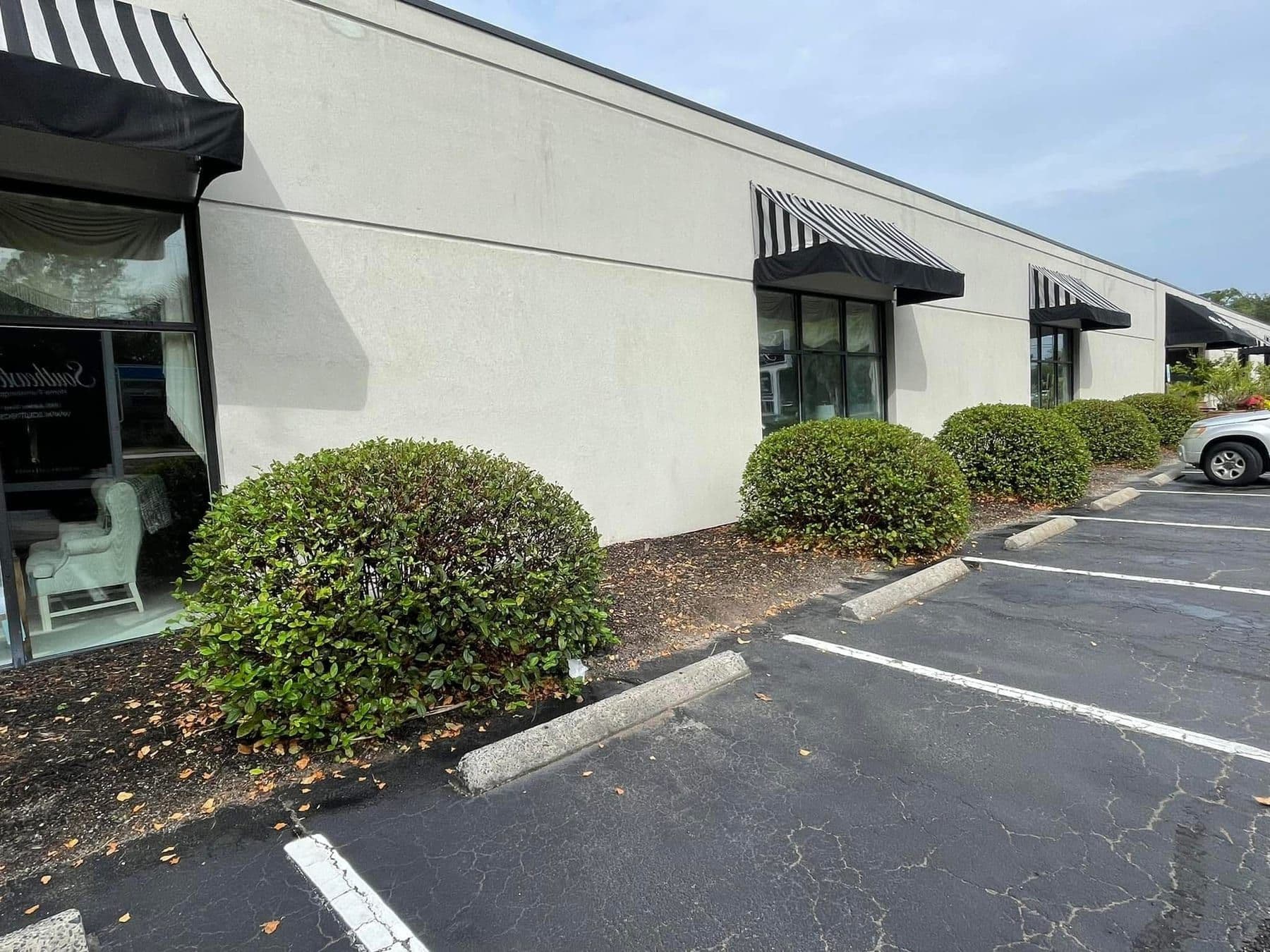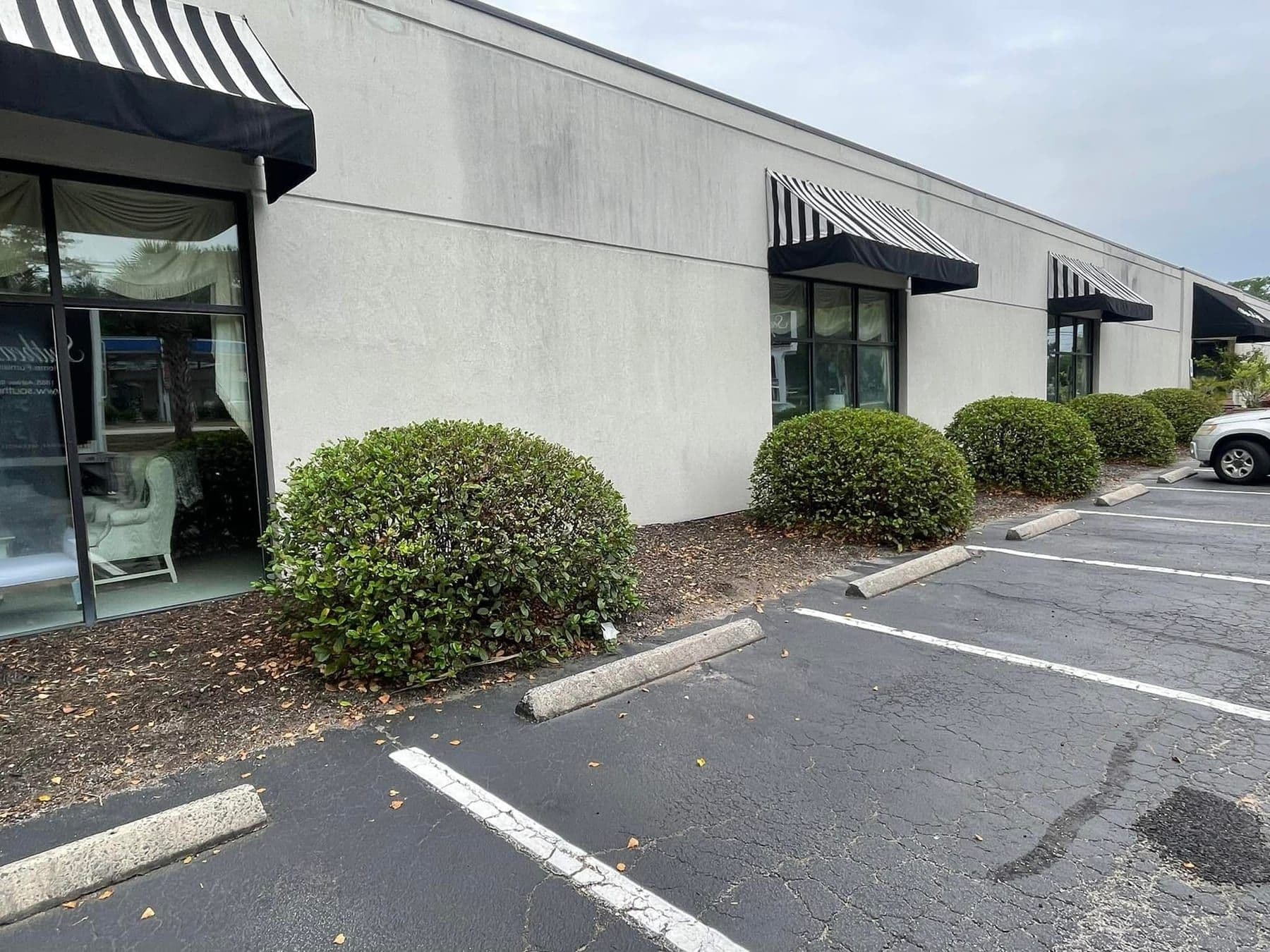
Fourteen tenants on a center off Rivers Avenue, and three of them called you this month about the same building from three different directions. The taco place's corral smells by Thursday. A tenant four doors down says her glass looks hazy. Somebody left a mattress by the compactor. That is not a cleaning program. That is a complaint queue with a checkbook attached.
Short version. A center is not one cleaning job. It is six surfaces on five different clocks, and the fastest clock belongs to whichever tenant makes food. Build the schedule around that corral, fold the slower surfaces in at their own intervals so the crew is already on site when they come due, and run it through the common area budget as one recurring line instead of a scatter of emergency invoices your tenants will question at reconciliation. No food tenant? Do not buy a program at all. I will get to why.
Six surfaces, five clocks
Nobody publishes a cleaning calendar for retail exteriors. I have gone looking. BOMA sells a Guide to Exterior Maintenance Management with checklists for housekeeping inspection, exterior conditions, and roads, grounds and parking (BOMA publications). Checklist book, not a calendar. Any contractor who tells you an industry body mandates quarterly anything is selling.
These intervals are ours, from running crews here.
Dumpster pads and corrals behind a food tenant: monthly through a Charleston summer, quarterly once the heat breaks.
Sidewalk in front of food tenants, and any door people queue at: monthly to every six weeks.
The rest of the sidewalk and the entry aprons: two or three times a year.
Building elevations: once a year. Shaded and north-facing walls green up first, so one bad elevation may want its own cycle.
Entry glass and frames: monthly, sometimes every two weeks with a grocery anchor.
Pylon sign and tenant panels: annually, same visit as the elevations, since we are already staged.
Washing a parking field and sweeping one are different services, and plenty of centers already have a sweeper. Do not pay us to wash a lot that needs a broom. Washing earns you the drive lane at the trash enclosure, the stained stalls by the anchor's loading area, and the entry apron off Sam Rittenberg where every car turns in and drips. Batching it into one mobilization is the whole argument for shopping center cleaning as a program instead of a series of phone calls.
The food tenant sets the floor
The FDA's model Food Code will not hand you a number either. It sets a condition standard: soiled receptacles and waste handling units "shall be cleaned at a frequency necessary to prevent them from developing a buildup of soil or becoming attractants for insects and rodents" (5-501.116(B)). The Annex to the 2022 Food Code says a regular cleaning schedule should be established and followed, but that line is about "physical facilities," which the Code defines as the structure and interior surfaces of a food establishment, not the corral outside. The receptacle language above is the part that reaches your pad, and it is a health code saying reactive is the wrong model.
Read it narrowly, though, because contractors quote it broadly. The Code binds the food establishment and its premises. It puts no duty on a landlord for a shared corral, and states and counties adopt the model Code with their own variations. Who holds the duty for a shared enclosure at a multi-tenant center is a lease question and a local permitting question. Usually the landlord maintains the enclosure as common area and the tenant handles its own waste inside it. Usually is not always. Read your lease, call your county health department. I clean pads, I do not give legal advice.
Operationally it is simpler. A corral washed monthly comes clean with a degreaser, dwell time and hot water around 180 degrees. A corral nobody has touched since spring has grease down in the slab, and two passes will not bring all of it back. Some of that is permanent.
What CAM absorbs, and what your tenants will argue about
Materials published by ICSC for its 2025 U.S. Law Conference, a workshop paper written by two outside real estate attorneys rather than an ICSC standard, describe CAM as what an owner spends to repair, maintain and replace the common areas. The list expressly includes "cleaning, sweeping," plus trash removal, restriping, landscape maintenance and an administration fee "usually in an amount equal to 10-15% of the CAM costs" (Workshop 12, Advanced CAM Issues). ICSC's tenant-side explainer names parking lots "particularly for cleaning, lighting, maintaining and snow removal" among the areas tenants fund (CAM Demystified). Tenants pay an estimate through the year, the landlord reconciles afterward, and the tenant covers the shortfall or takes a credit.
Lease type decides how visible the cost is. Holland & Knight's comparison of triple net, gross and modified gross leases is plain: NNN passes operating expenses through, a gross lease "incorporates additional rent costs" into a fixed monthly fee, and modified gross uses a base year. Gross does not mean the owner absorbs the cleaning; the tenant still funds it, without a line to argue about. Fixed CAM goes further, a fixed dollar per square foot with fixed annual increases, which the ICSC workshop paper says makes inclusion lists, exclusion lists, caps and audit rights unnecessary. Under Fixed CAM you carry the variance, so predictability is worth more to you.
The denominator matters more than the rate
A tenant's share is pro rata, and the paper spends real time on the denominator. An anchor that owns its parcel, a third-party-owned outlot, and a landlord-owned outlot on a triple net lease that maintains itself may all need to come out of it. So match the crew's scope to the parcels you actually bill. If we wash the pad at a bank outlot that maintains itself, that invoice belongs on that tenant, not in the pool.
Invoice like you expect to be audited
Many retail leases use catch-all CAM language with no carve-outs, so tenants negotiate exclusions for initial development costs and capital expenditures, though the paper notes a tenant can and should agree to intermittent paving or repainting when the cost is amortized. Tenants also negotiate audit rights, and caps usually apply to the controllable bucket. The uncontrollable list in that paper is snow and ice removal, utilities, security and law-change costs. Exterior cleaning is not on it, which in most leases leaves it inside whatever cap applies.
So bill it the way you would want to defend it: date, surface, square footage, method, before and after photos. Keep tenant-caused work out of the pool, since a grease overflow from one kitchen or graffiti on one roll-down belongs to that tenant. That fight starts at the sidewalk, which is why I wrote a separate piece on whether the tenant or the landlord cleans the storefront sidewalk.
Why a callout costs more per visit than a scheduled stop
Most shopping center pressure washing in Charleston gets bought one emergency at a time. No source I can find prices callouts against scheduled visits, so I will argue this from our own cost structure.
Every visit carries a mobilization: truck, water, drive time, setup, cones, often an off-hours access window. On a scheduled stop that spreads across a corral, a run of sidewalk and the entry glass. On a callout it buys one surface. Reactive work also arrives in the worst condition it will ever be in: more chemistry, more dwell, more heat, sometimes a result that is only better rather than clean.
The framing is borrowed and I will say from where. The DOE's Operations and Maintenance Best Practices Guide lists run-to-failure costs as increased labor "especially if overtime is needed," possible secondary damage, and repairs more extensive "than would have been required if the piece of equipment had not been run to failure" (FEMP O&M Best Practices, Chapter 5). That guide is about motors and filters, and its savings percentages are about equipment. The mechanism carries over to a wash schedule. The percentage does not, and I would be skeptical of anyone who quotes you one.
How to write the scope so three bids mean something
What I would want if I sat on your side of the table, whoever you hire.
Square footage per surface, and an interval per surface. One blended annual number hides everything.
Access hours, who holds the keys, which tenants get notified.
Water source. Which spigot, whose meter, what happens if it is dead. Hauling water prices differently.
What done looks like, per surface. Uniform color on concrete is fair. Removal of every stain is not, and a bid promising it is padded or about to disappoint you.
Heat where it is specified. Grease and gum need it. Painted stucco and EIFS need low pressure instead, under 500 PSI, with detergent doing the work.
Insurance and chemistry. We carry $2,000,000 general liability and send the certificate before work starts, with your ownership entity named additional insured when the management agreement requires it. Plant-safe surfactants and biodegradable detergents matter where irrigation beds sit tight against the concrete. If it is not right, we come back.
Scope storefront and sidewalk cleaning as its own line instead of burying it in a building wash.
When I tell an owner not to buy a program
Here is the honest limit of what we sell. Our recurring pricing assumes a mobilization spread across enough surfaces to justify the trip. On a six-suite strip with a salon, an insurance office and a dry cleaner, there is no grease and no corral traffic, so you would mostly be paying us to show up. Bad deal. Once or twice a year on a call is the right answer for that center, and I say so on the walk.
Clean beats fancy, too, which is easy to forget when somebody pitches a facade refresh. ICSC's 2014 guide for commercial district practitioners, written about downtown districts rather than privately owned centers, notes that "some of the most successful shopping districts in the country ... have nothing but simple, clean concrete sidewalks" (Improving Tenant Mix). The same guide puts cleanliness and maintenance among the fundamentals to handle before recruiting tenants.
A reasonable next step
Walk the center twice with your phone. Once around 1:30 in the afternoon on a weekday, after the lunch rush has fed the corral, and once first thing Monday. Photograph the pad behind the food tenant, the sidewalk in front of it, the entry glass at the busiest suite, and the elevation the sun never reaches. Those four pictures will set your intervals faster than any bid.
If you want it priced, send the site plan, tenant list and access hours through our quote form, or call 843-696-4739 and ask for a walk. If the honest answer is that your center does not need a program, you will hear that instead.