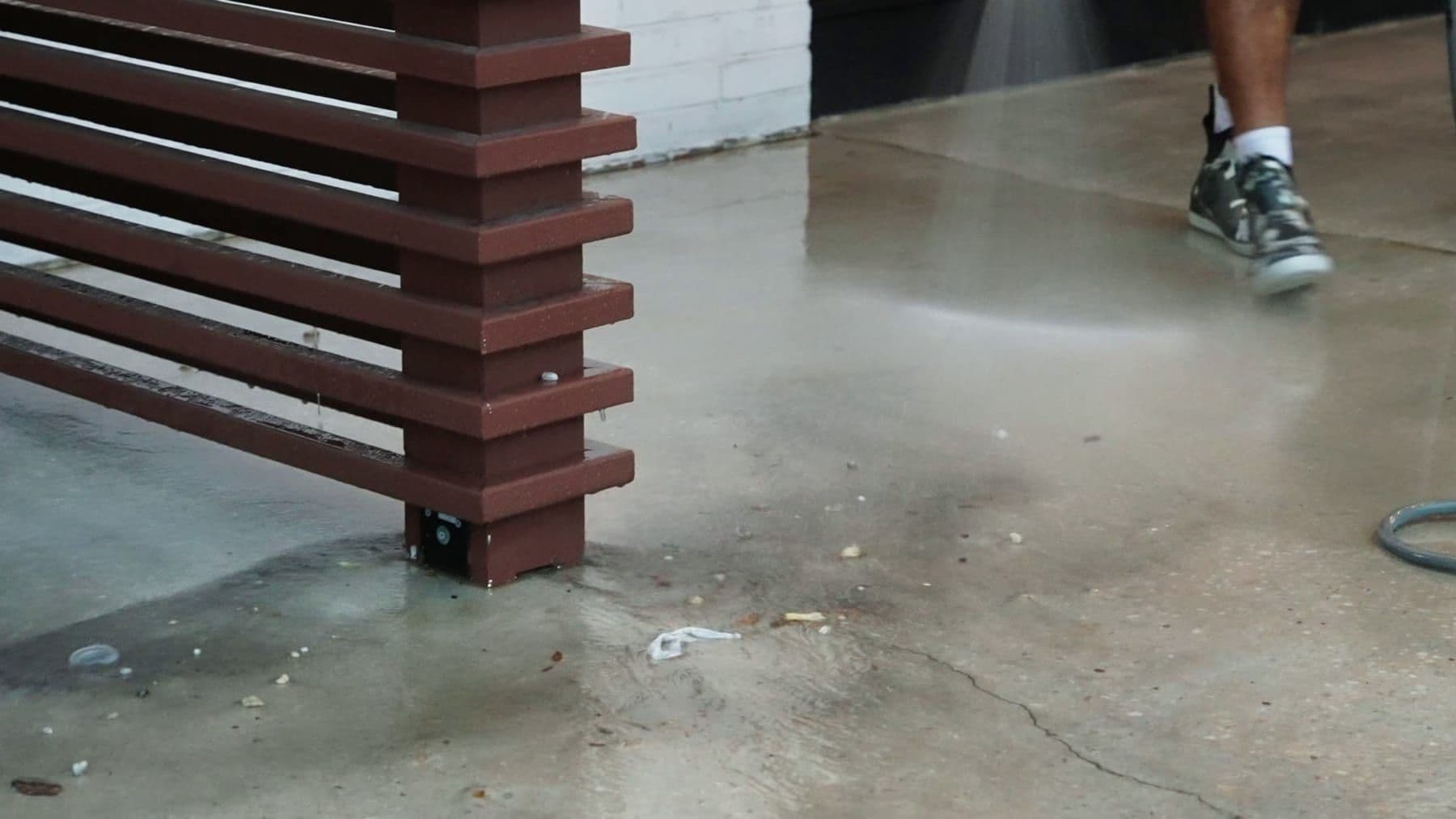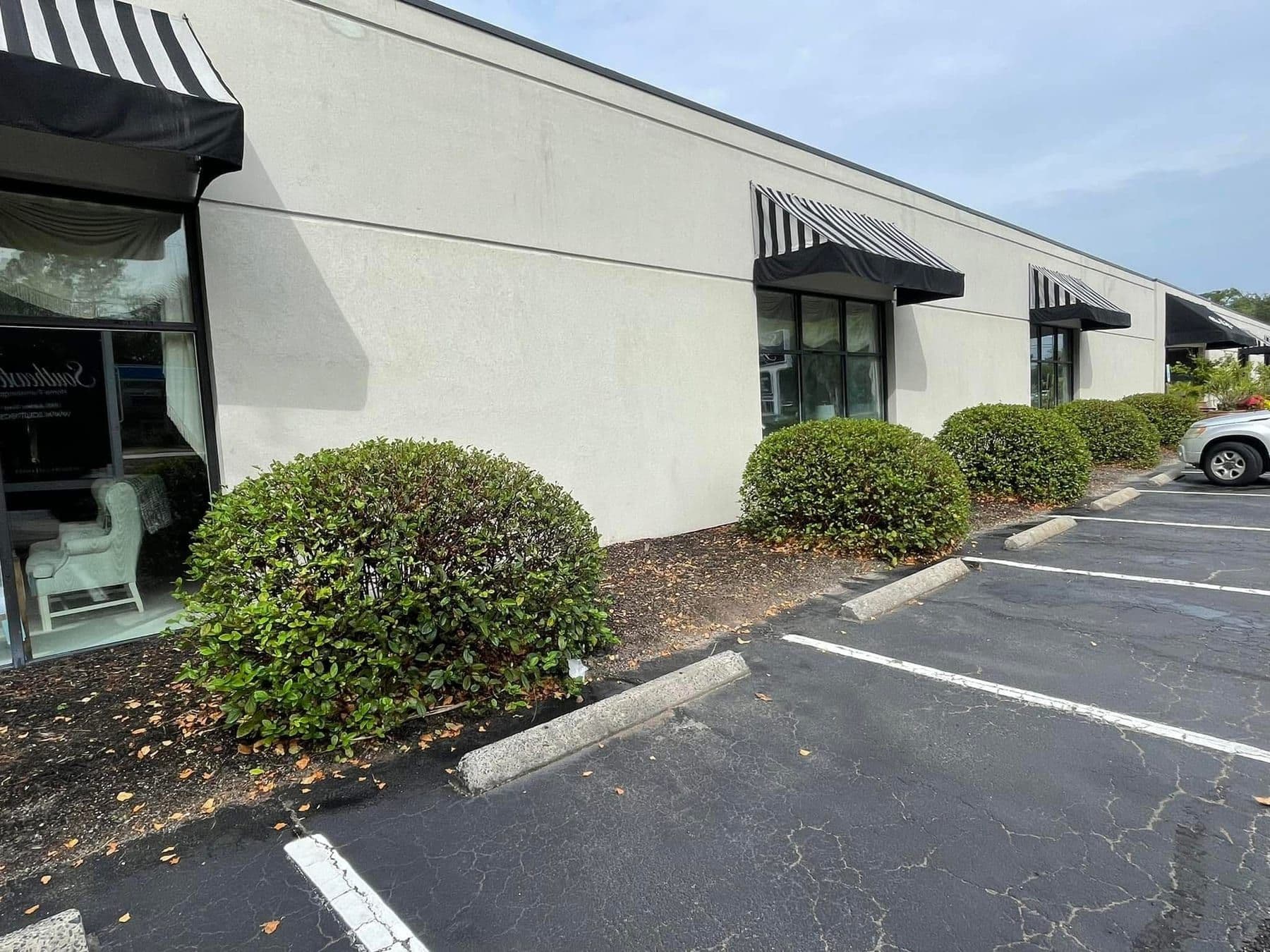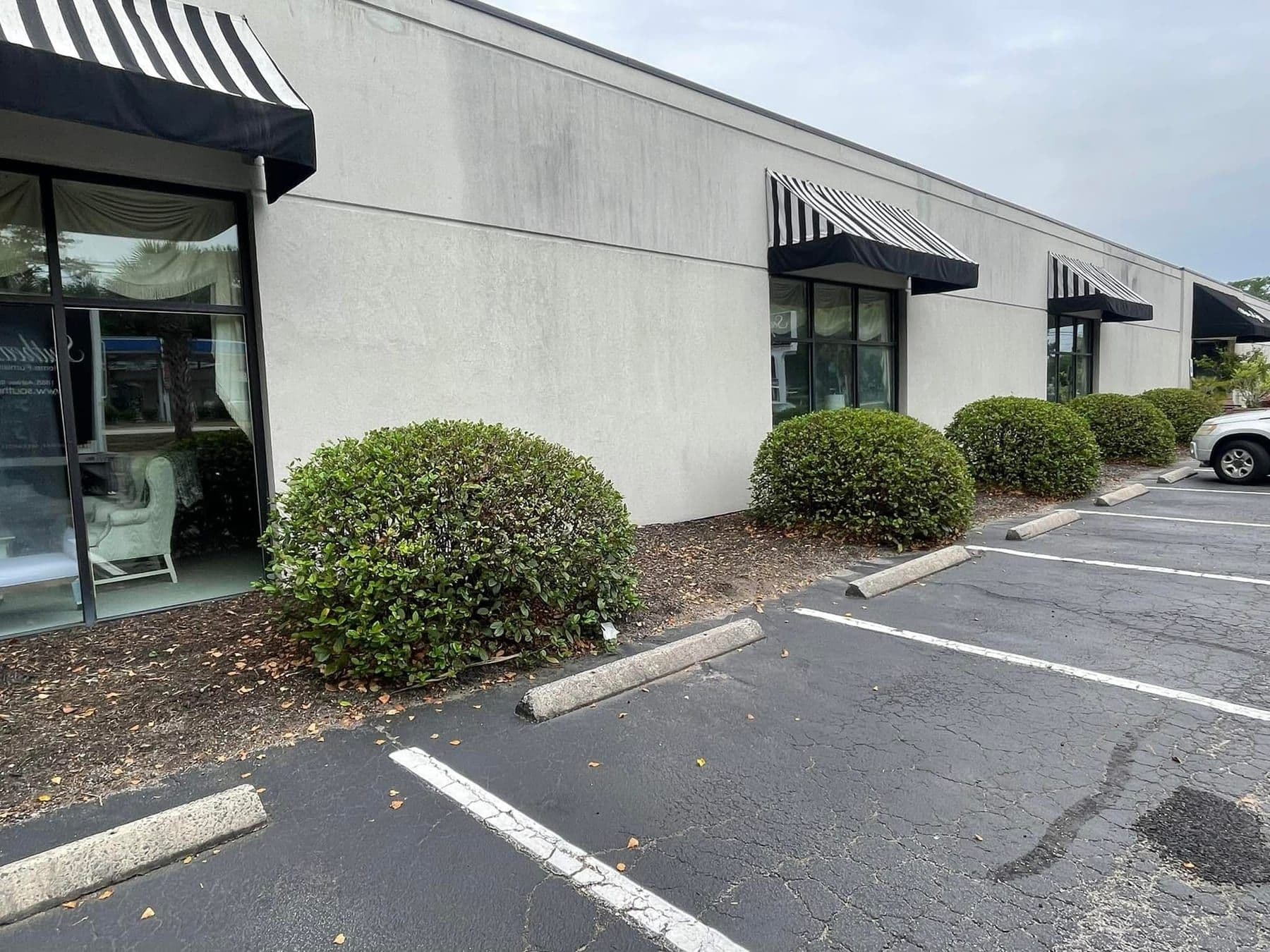
Your customers walk across the worst concrete on the property before they ever touch a door handle. That is the forecourt. Every drip at the nozzle, every overfill, every quart of oil somebody topped off beside pump three, in plain view of the road.
Short answer first. Yes, a fuel island can be pressure washed here. No, the wash water cannot go into the storm drain. It gets kept out of the inlets, recovered, and taken somewhere lawful. That constraint drives the method and the price far more than the staining does, which is why the cheap bid and the real one sit so far apart on Gas Stations & C-Stores work.
Why the pad stains the way it does
It is not only fuel. A widely used California design handbook, Fact Sheet SD-30 on fueling areas, lists what these areas contribute: oil and grease, solvents, car battery acid, coolant and gasoline. That sheet is California, dated January 2003, and it covers new development design rather than anything South Carolina requires. The list still matches what our crew scrubs off a Rivers Avenue forecourt.
Then add tire polymer. Cars pivot at low speed inside the same few feet of concrete around each dispenser, over and over. Rubber binds into the oil film and leaves a gray-black skin that a cold-water rinse only polishes. People read that as old concrete. It is not old. It is loaded.
The same sheet says what a fueling pad should be: Portland cement concrete rather than asphalt, graded to drain toward a dead-end sump, with storm drains kept out of the immediate vicinity of the fueling area. Most of the forecourts I walk are built close to that, under their own local codes rather than a California recommendation. A site built that way makes Commercial Concrete Cleaning on the forecourt much simpler. One protection is already under your pad: any new dispenser system installed after April 11, 2016 needs liquid-tight under-dispenser containment under 40 CFR 280.20. That handles what leaks down, not what runs sideways.
The SPCC question, answered the right way around
Most contractor blogs have this backwards. EPA says gas stations typically are not subject to the SPCC Rule, because completely buried storage tanks subject to 40 CFR Part 280 or 281 are exempt. South Carolina runs an EPA-approved Part 281 tank program (40 CFR 282.90), which is what makes that exemption operate at a station on Sam Rittenberg.
Where SPCC bites is aboveground. In EPA's words, a gas station would be subject if it has more than 1,320 gallons of oil in aggregate aboveground storage capacity. An aboveground diesel or used-oil tank can put you there. The buried gasoline does not. At a site regulated for that reason, EPA says dispenser transfer areas fall under the secondary containment requirement in 112.7(c), with no specifically-sized containment required, though EPA says the size must still be based on good engineering practice, and active containment such as sorbent deployment counts.
The rule that actually governs your wash
Wash water is not stormwater. That is the whole thing. Under 40 CFR 122.26, an illicit discharge is any discharge to a municipal separate storm sewer not composed entirely of storm water, with two carve-outs: a separate NPDES permit, and firefighting. Pressure washing is neither. The Clean Water Act requires municipal storm sewer permits to effectively prohibit non-stormwater discharges, and 40 CFR 122.34 makes small MS4 permittees do that through an ordinance or other regulatory mechanism, and enforce it.
Charleston's Stormwater Design Standards Manual from September 2025 puts gas stations in its table of typical commercial illicit-discharge sources, and lists power washing and vehicle fueling among typical activities. That is an illustrative table, not an ordinance naming pressure washing, and I would not let a contractor tell you otherwise. The City's ordinance hook sits in Chapter 27, described in its own 2014 stormwater plan as prohibiting illicit discharges and letting the City fix a violation and bill the owner. Check current section numbers before quoting them. North Charleston uses the same definition. Same reasoning we walked through on wash water and stormwater rules on a dumpster pad, with fuel in place of grease.
How we run a forecourt
Dry cleanup first, always. Sweep, absorbent on anything fresh, scrape the gum. Whatever comes up dry is something nobody has to filter later. Inlets get protected before a trigger gets pulled: mats, plugs, berms, whatever the drain geometry takes.
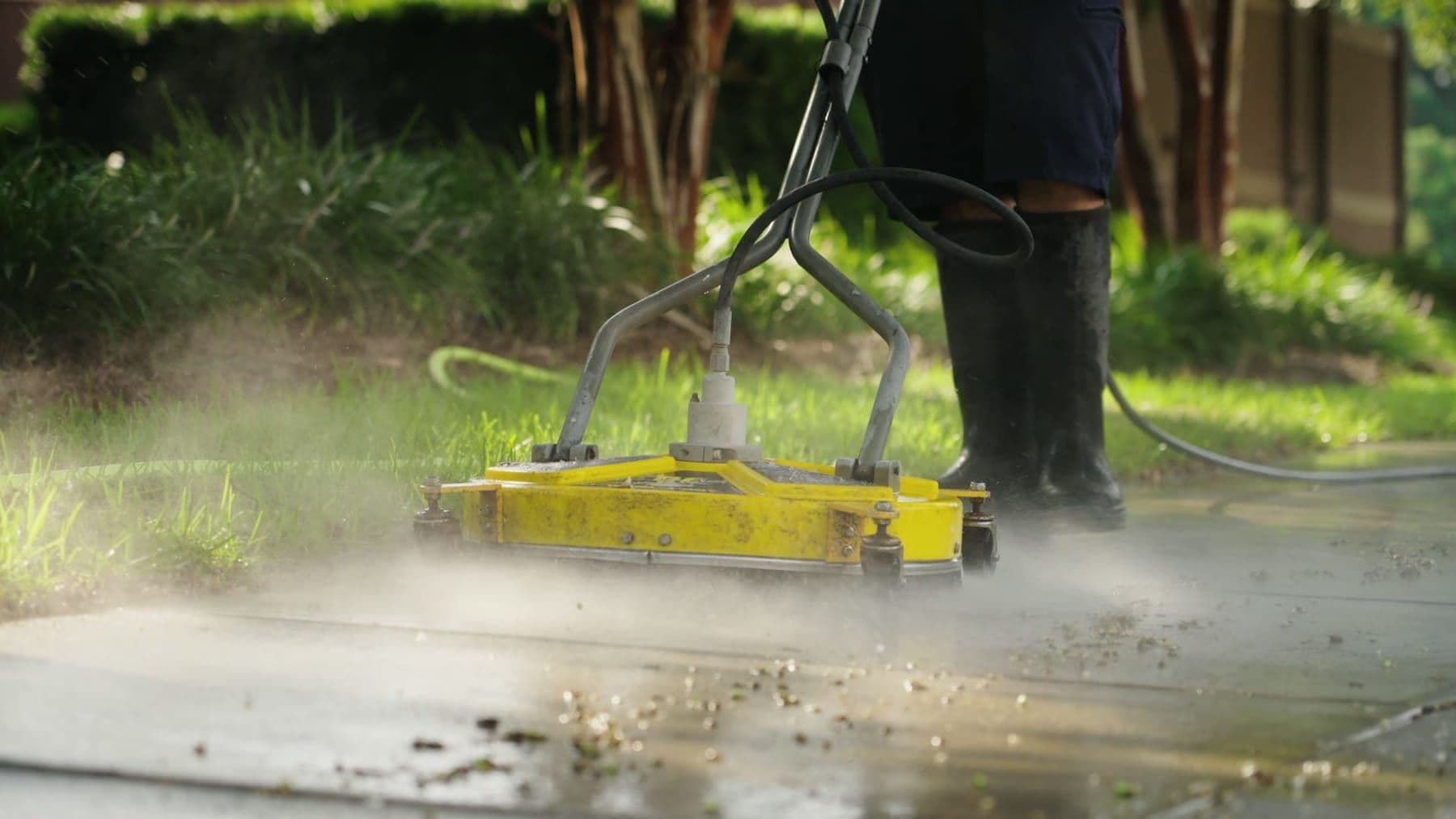
Then heat. A surface cleaner in the 3,500 PSI range at 5 to 8 GPM, water around 180 degrees at the tip, and a degreaser given real dwell time instead of a fast rinse. We run plant-safe surfactants and biodegradable detergents, which matters on a pad sitting a few feet from landscape islands. Recovery comes off a vacuum boom into a tank while the surface cleaner moves.
South Carolina's environmental agency states the bar cleanly in its industrial stormwater permit, telling operators to ensure that all wash water drains to a proper collection system (i.e., not the stormwater drainage system). That permit binds facilities holding coverage under it, and a retail station does not. It is still the standard we work to.
Where the recovered water goes
The same permit names the lawful destinations for vehicle and equipment wash water: a separate NPDES permit, the sanitary sewer under applicable industrial pretreatment requirements, or other disposal in accordance with law.
The sewer is not an automatic yes. 40 CFR 403.5 prohibits wastestreams creating a fire or explosion hazard, including a closed-cup flashpoint below 140 degrees Fahrenheit, and petroleum oil in amounts causing interference or pass through. Charleston Water System permits any discharger with the potential to negatively impact the sanitary sewer system. So the destination gets arranged in advance, or the water gets hauled off. Anybody who shrugs and points at your mop sink is guessing with your name on the violation.
The canopy, and what cleaning it does not do
Fascia and deck collect road film, exhaust and salt, and on Coleman Boulevard the salt does most of the damage. We clean it from the ground, low pressure, soft wash chemistry.
Here is what nobody selling canopy work will tell you. Cleaning the deck does not put light on your pad. The only mechanism I can point to is luminaire dirt depreciation, which a Department of Energy report on light loss describes as one of three recoverable factors the IES Lighting Handbook lists, and that is dirt on the fixture and lens. Clean the lenses and light comes back. Clean the ceiling and you get a clean ceiling, worth something after dark, just not in lumens.
Where our job stops
We are not a spill response contractor. No remediation, no environmental consulting, and we do not write or review SPCC plans.
The line sits in the regulation. Under 40 CFR 280.53, a petroleum spill or overfill releasing more than 25 gallons to the environment, or causing a sheen on nearby surface water, must be reported to the implementing agency within 24 hours, and the owner or operator must contain and immediately clean it up. 40 CFR 110.6 puts the notification duty on the person in charge of the facility, to the National Response Center at 800-424-8802. If our crew finds that, we stop and tell you. It is your release to report, not ours to wash away.
What to ask before anybody unrolls a hose
Useful whether you hire us or the guy with the trailer.
Where does the water go? Make them describe recovery and disposal in specifics, not adjectives.
What protects the inlets, and does it go down before the water starts or after?
Is dry cleanup happening first, or is the plan to mobilize the mess with a wand?
Certificate of insurance before work starts, plus additional insured status if your management company wants it. We provide the COI, carry $2,000,000 general liability, and come back if something is not right.
Who calls the municipality with a site question? Your lease may put forecourt maintenance on your landlord. Read it, then call the city.
A next step that costs nothing
Walk your forecourt after dark this week. Look up at the light lenses, then down at the concrete under the pumps. Whatever you notice, a customer noticed at fill-up. Want the containment and disposal plan in writing before you commit? Ask us for a quote or call 843-696-4739.