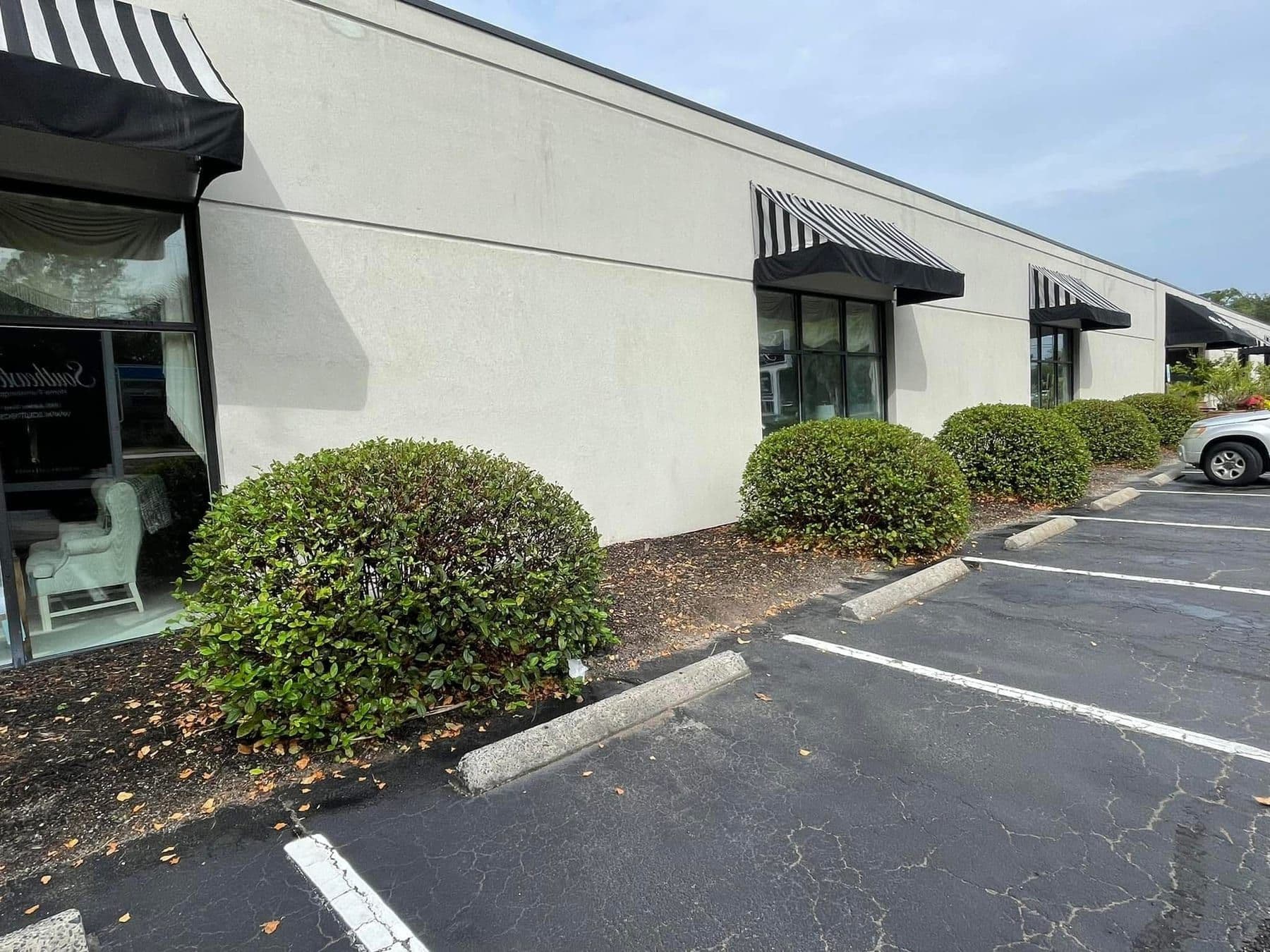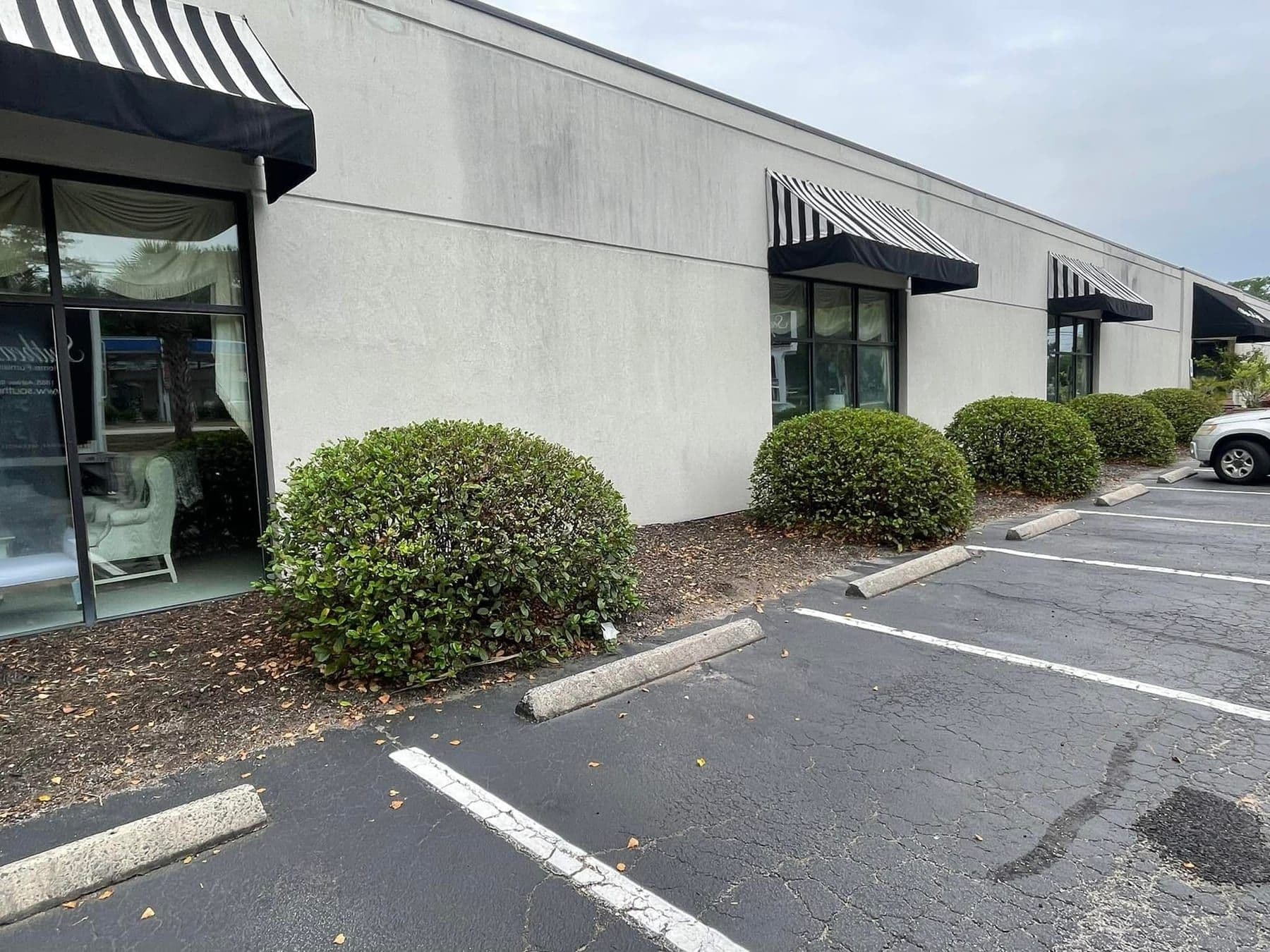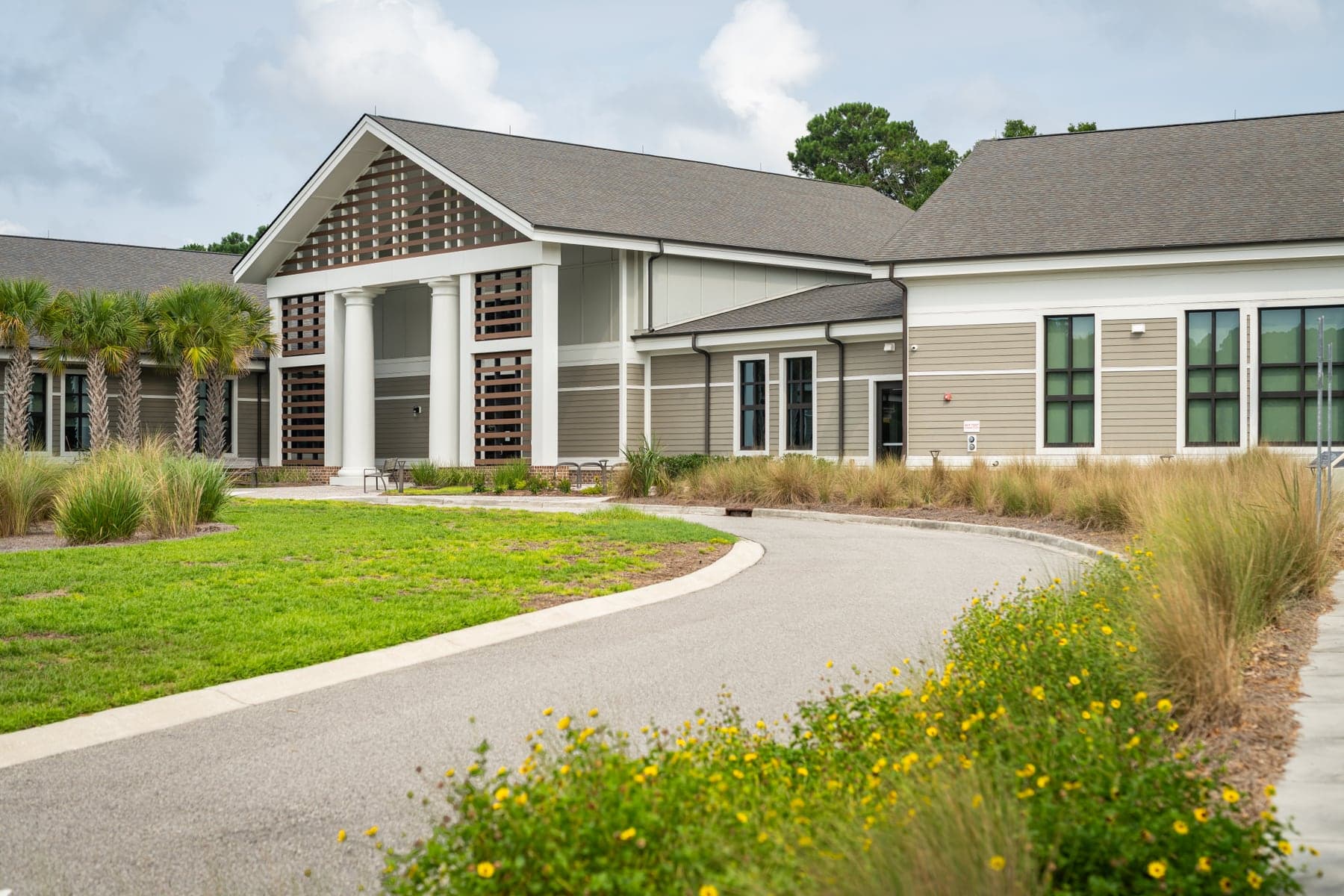
Your first appointment is at eight. The walkway from the accessible spaces to your front door is streaked gray, the entry canopy has growth on its north face, and your property manager wants this handled without one patient complaint and without a tenant calling the front desk about a smell in the lobby.
Short version: we start early, usually before first appointments, and we sequence the job so the route from the accessible parking to the entrance is washed, rinsed and dry before the doors unlock. Not a weekend. Plenty of practices off Johnnie Dodds and out at Nexton run Saturday hours, and the City of Charleston's noise ordinance, Sec. 21-17, building construction operation noise allows a 7:00 a.m. weekday start but nothing before 9:00 a.m. on Saturdays, with nothing at all on Sundays or six named City holidays. Whether a washing job sits inside that language is the City's call, not mine. Call the permit centre and ask. And do not assume the answer travels to North Charleston, Mount Pleasant, Summerville or Goose Creek, because each has its own rules and I have not read them all.
Start before the first appointment, not on a Saturday
The scheduling argument is not mine. It belongs to the EPA and NIOSH, whose guide for building owners and facility managers treats housekeeping and maintenance as a recognised indoor air quality problem category, gives "Cleaning products emit chemicals, odors" as an example, and lists as a solution shifting the time of cleaning and other contaminant-producing activities to avoid occupied periods. The same guide treats contaminants entering from outdoors as a separate problem, names an outdoor air intake near a source as a cause, and again offers shifting the time of the activity as the fix.
I will be straight about that citation. To be fair to the guide, it names our activity outright. Problem #11 lists "shift time of painting, cleaning, pest control, other contaminant-producing activities to avoid occupied periods," and the outdoor-contaminant entry puts housekeeping right beside painting, roofing and demolition. What it does not do is say a word about exterior washing specifically, or about how long a walkway stays wet. That part is mine, not the EPA's.
Early solves things the guide never mentions anyway. Empty parking. Nobody crossing wet concrete with a walker. Surfaces dry fast once the sun is up in July and they do not in February, which changes how long we hold a section closed.
The accessible route: what the ADA actually says
This gets misquoted constantly, including by people bidding your building, so it is worth being exact.
The 2010 ADA Standards do not define "accessible route" in their defined terms at all. I went and read Section 106.5. It defines "Accessible" as a site, building, facility or portion of one that complies with the part. It defines "Circulation Path" as "An exterior or interior way of passage provided for pedestrian travel," and the list that follows includes walks, courtyards, ramps, stairways and landings. There is no entry for "accessible route." If someone quotes you a crisp definition from 106.5, ask where they got it.
What matters operationally is Section 206.2.1, Site Arrival Points, which requires at least one accessible route within the site from accessible parking spaces and passenger loading zones, public streets and sidewalks, and transit stops to the accessible entrance they serve. That is the provision tying your lot to your door.
Two things people get wrong:
The ADA does not require an accessible route to be dry. Section 302.1 requires ground surfaces to be "stable, firm, and slip resistant," which describes how the surface is built, not an operating rule that it never be wet. We dry it anyway. Not because a code says so. Because a patient with a walker on wet concrete at 7:55 a.m. is a bad outcome and I do not want to be the reason.
The ADA does not require the route to stay open while it is being cleaned. That maintenance duty is not in the Standards. It sits in the Justice Department's Title III rule at 28 CFR 36.211, which requires a public accommodation to keep accessible features in operable working condition and then says plainly that the section "does not prohibit isolated or temporary interruptions in service or access due to maintenance or repairs." Public entities such as a county clinic get the same language at 28 CFR 35.133.
Notice who those rules bind. The public accommodation or the public entity, meaning the practice, the owner or the property manager. Not the cleaning contractor. We plan around your duty and we help you meet it. But a bidder who tells you that hiring them makes the building compliant is selling you something, and where the responsibility actually sits between you, your landlord and a contractor is a question for your own counsel and your service agreement, not for me.
In practice we work a walkway in halves and keep a continuous path of at least the 36 inches of clear width Section 403.5.1 sets for walking surfaces, never dipping to the 32-inch reduction the exception allows for more than the 24 inches of length it allows. Where a walk is too narrow to split, we take a short full closure that ends before the doors open, and we give your front desk in writing which door the early arrivals should use.
Patient drop-off, and the rule people misquote
The ADA requirement for a passenger loading zone at an accessible entrance applies to "licensed medical care and licensed long-term care facilities where the period of stay exceeds twenty-four hours." That is Section 209.3, and it is written for places where people stay overnight, which is usually not an outpatient practice or a professional office building. Do not take that from me, though. Outpatient buildings have their own scoping elsewhere in the Standards, including the accessible parking counts at 208.2.1 and 208.2.2, so let your architect or your counsel tell you what actually applies at your address.
Operationally it does not matter one bit. The drop-off is where your most fragile arrivals get out of a car, and it is also the one lane a truck and a hose reel want to sit in. So we take it first, finish it first, and keep a crew member on the lane with cones rather than closing it. If your practice happens to be Joint Commission accredited, the Commission's own Standards FAQ on grounds maintenance frames grounds work as a matter of safe ingress and egress and names patient drop-off zones, pedestrian walkways, sidewalks, ramps, stairs and vehicle parking, referencing standard EC.02.01.01. That is an interpretive FAQ about safe access, not a cleanliness or frequency requirement, and accreditation is voluntary, so it may simply not be your world.
The fresh-air intake is what gets you the phone call
I am not going to give you a distance to keep chemicals away from an intake, because I cannot find a published number for this activity and the numbers that get quoted are borrowed from somewhere else. The 25-foot figure floating around comes from EPA's design guidance for schools. ASHRAE Standard 62.1 does set minimum intake separation distances, 15 feet from dumpsters and 25 feet from a truck loading dock in the 2016 edition's Table 5.5.1, renumbered Table 5-1 in the 2022 edition. Read what that is. It tells a designer where to put an intake relative to fixed things. Cleaning is not on the list and the standard asks nothing of a crew.
So we do it by walking it. We ask your building engineer to point out every outdoor air intake, mark them on the site plan, work downwind of them, stage detergent away from them, and where a surface sits directly below one we ask whether that unit can be off or on recirculation for the window we are working. That last call belongs to the engineer, not to me.
The thing you are avoiding here is an odour complaint, not harm. I am not making a health claim about detergents and patients because I cannot support one. What I can tell you is that a waiting room full of people who already feel unwell will notice a smell, and one of them will say something. We use plant-safe surfactants and biodegradable detergents, which also matters for the landscape beds most medical parks pay someone else to keep alive.
Noise is the part I cannot fix
Here is the honest limitation of how we work. A pressure washer is loud, I cannot make it quiet, and I am not going to quote you a decibel figure I have not measured myself. On a practice whose first appointment is at seven, we are either working in the dark or we are not working that morning.
Dark is workable with lights and it costs you something real. We cannot read the finish under a work light the way we can at nine, and streaking shows up in daylight that did not show up at five. When a job goes that early we plan a daylight walkthrough afterward, and if a section needs a second pass it gets one. That is what our re-do guarantee is actually for.
Sequencing helps more than anything else. Loudest work closest to exam room windows goes first, while the building is empty. The far end of the lot goes last, because if we run into your occupied hours out there, nobody in an exam room hears it.
The walkthrough you can run without me
Do this yourself the week before, whoever ends up doing the work. It takes twenty minutes and it prevents most of the arguments.
Walk the route from the accessible spaces to the accessible entrance with a tape measure. Find the narrowest point and the spots where a half-width closure will not fit.
Get two times from the practice manager, not one: when the first patient is scheduled and when a staff member actually unlocks the door. They are different.
Ask your building engineer where the outdoor air intakes are. No engineer? Ask the landlord and look at the mechanical yard and the roof line yourself.
Find the spigot and confirm whose meter it feeds. On a multi-tenant professional park this is not always the tenant asking for the work.
Trace where the wash water goes. Every parking lot inlet drains somewhere, and the answer changes the method.
Confirm who owns the walk in front of your suite before you schedule anything, because in a multi-tenant building it is often not the tenant standing on it. I wrote up how that responsibility usually splits between tenant and landlord in a lease, though your lease is the one that governs, so read it or have your attorney read it.
Write the job as a sequence with times, not as a list of surfaces, and hand the identical sequence to every bidder. Otherwise you are comparing three different jobs.
Glass, gutters and what we reach from the ground
Everything we do on a medical or professional building is ground-based. That shapes what we can promise on a taller elevation, and it is worth saying out loud before a proposal rather than after. Entry glass, storefront glass and reachable elevations are ordinary commercial window cleaning work and pair well with the same early morning visit, since the crew is already staged and the lot is already empty. Gutter and canopy work on a single-story or low professional building fits the same window. Anything higher than we can safely reach from the ground, I will tell you we are not the right call.
What to do next
If you are only pricing this, ask any bidder for their certificate of insurance before a hose comes off the truck. Ours shows $2,000,000 in general liability, and where a property manager requires it we can name the client as additional insured. Then ask for a written sequence with a start time and a doors-open time on it.
If you want us to walk your building, we cover offices and practices across office and medical properties in Greater Charleston, and you can tell us your first appointment time and get a scoped quote or call 843-696-4739. Even if you never hire us, take the sequence idea to whoever you do hire. It is the part that keeps a wet walkway away from a patient with a cane.