Turn season does not go sideways because somebody cannot clean a breezeway. It goes sideways because the crew shows up on the wrong Tuesday, at the wrong building, while a resident is carrying a couch down the only staircase.
So, the answer first. Sequence the work building by building, in the order your leasing agent walks a prospect, and clean each one in the gap between its last move-out and its first move-in. Breezeways, stairwells and the dumpster corral cause most of the tour objections and most of the resident complaints. Do those before the photographer, not after.
Turn work is a scheduling problem wearing a cleaning problem's jacket.
Turn here is summer weighted, and I am not quoting you a curb appeal statistic
I went looking for numbers tying exterior condition to lease-up speed and found none with a study behind them, so I am leaving that out.
Calendars are better anyway. The Department of Defense puts its peak moving season at May 15 through September 30, per Military OneSource's PCS and moving FAQs, and if your property sits off Rivers Avenue or up in Goose Creek, a real share of your turn traffic runs on that clock. Then the students. College of Charleston housing says Fall 2026 move-in is August 14 and 15, by appointment, and the registrar has classes starting August 17 after May commencement. Plan backward from those dates, not from your fiscal calendar.
Sequence building by building, in tour order
Ask the leasing office to walk you the tour route. Not the site map; the actual path a prospect takes from the parking spot to the office, past the model, out to the amenity. That path gets cleaned first.
Then pull the move-out report and cluster it. A building with four notices earns a full pass, because the breezeway will take punishment from movers anyway and you would rather clean once, after the couches, than twice. A building at full occupancy with one notice gets the corral and the ground-level walk only. Our crews finish one building before opening the next. Slower, and far less disruptive to the people living there.
Breezeways are the first thing a prospect walks past
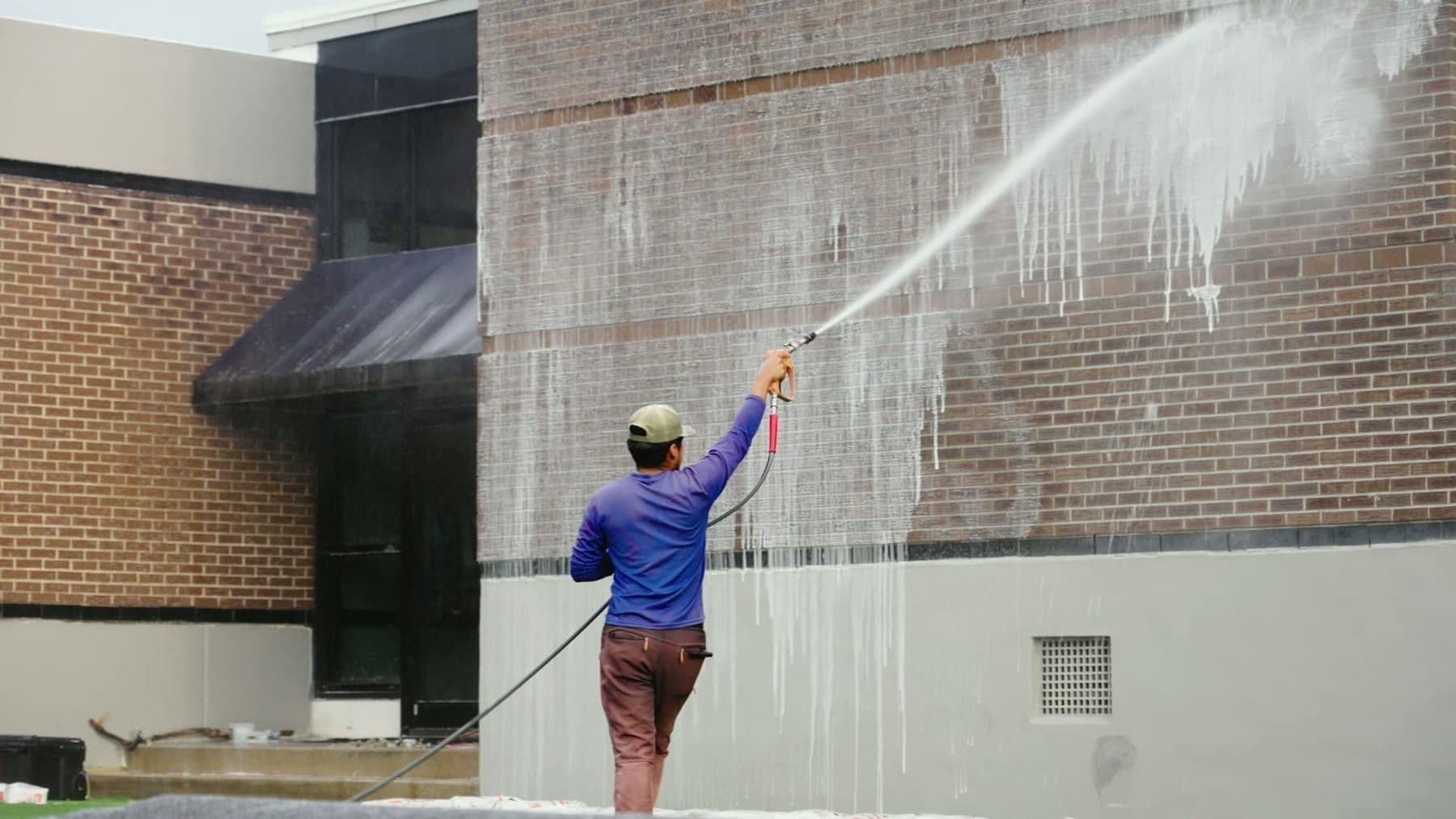
A Charleston breezeway collects pollen film in spring, mud dauber nests in the corners, algae on the shaded side, and a dark trail of trash drippings toward the stairs. Ceiling decks and railings are usually painted, so those get soft washed under 500 psi at the surface, with plant-safe surfactants doing the work instead of the wand. The deck takes a surface cleaner at roughly 3,500 psi and four to five gallons a minute, which keeps wand stripes out of the concrete.
What matters on an occupied building is water direction. Breezeway doors have thresholds, and thresholds leak. Our guys work away from the doors and push water off the deck edge rather than down the walkway toward the last unit. Ask any bidder how they handle that; it is ordinary practice in apartment and multifamily exterior cleaning and plenty of them have no answer.
Stairwells, and the building where the stair is the only way out
On a lot of these buildings the exterior stair is the egress route, and the fire code treats it as one the whole time the building is occupied. The maintenance rule is Section 1032.2, Reliability. Virginia republishes its own version of that chapter for free, and it reads: "Unless otherwise permitted by the applicable building code, required exit accesses, exits, and exit discharges shall be continuously maintained free from obstructions or impediments to full instant use in the case of fire or other emergency where the building area served by the means of egress is occupied." That is Virginia's amended fire prevention code and not the text a South Carolina marshal enforces, so treat it as the shape of the rule, not the local wording. What is local is the edition: the City of Charleston says its Fire Marshal Division "enforces the 2021 International Fire Code". If you want the words that bind your property, ask the Fire Marshal Division for the section.
Single-stair low rise is code recognized, not an edge case. The 2021 IBC allows a single exit for R-2 occupancies on the basement, first, second or third story above grade plane, and Table 1006.3.4(1) caps it at four dwelling units per story and 125 feet of exit access travel distance, with the building sprinklered under Section 903.3.1.1 or 903.3.1.2 and emergency escape and rescue openings provided. The fire code side is short: a single exit approved under the building code "shall be maintained." So I do not plan on closing that stair for twenty minutes, and I would not take a bidder's word that a short closure is fine. Your fire marshal is the one who says what your building allows.
So we clean one flight at a time, top landing down, hose along one side, half the tread width open, and somebody at the bottom who moves for anybody carrying a box. Slower, yes. None of that is a code opinion from me. Your fire marshal is the authority on egress, and your management agreement decides who signs off.
The part we cannot fix
We cannot clean a breezeway or a set of stair treads without them being wet, and on a humid August afternoon this close to the water, concrete dries slowly. Blowers and squeegees cut the time down. They do not eliminate it.
On a single-stair building that is a real inconvenience for every resident above the ground floor, and nobody has solved it, us included. What we do instead is take those buildings first thing in the morning, cone the flight we are working, and give the property lead time to notice residents.
The dumpster corral nobody wants to look at
Corrals fail on organics, not on dirt. Sugar and grease bake into the slab, and cold water at high pressure mostly relocates them. Hot water is the difference, in the neighborhood of 180 degrees at the gun, with a biodegradable degreaser left to dwell before the surface cleaner comes through.
The other half is where the water goes. A corral pad usually drains toward a storm inlet, and wash water carrying grease has no business in there. I wrote a longer piece on wash water and stormwater rules on a dumpster pad, and the same thinking drives how we handle commercial concrete cleaning anywhere on a property with inlets.
A turn sequence you can run with your own maintenance crew
If you have an in-house team and a machine, you do not need us for this. Run it in this order.
Number every building and mark the tour route on a printed map. The crew works off the map, not off memory.
Walk each breezeway with the move-out report. Note door sweeps, loose railings, dead lights.
Corral and ground-level walks first. Unoccupied space, loudest work.
Breezeways next, top floor down, one building start to finish.
Stairs last, top landing down, half width open.
Photos after the building dries, not the same afternoon.
Re-walk the tour route the morning of the first tour. Somebody will have left a mattress on it.
Check spigot pressure before the day starts, and know which exterior outlets are live, because on an older property in Northwoods or off Sam Rittenberg, half of them are not.
Noise windows, notices, and paperwork
Charleston restricts the hours during which loud powered equipment can run for construction, repair and renovation work, and other municipalities set their own. I could not verify the current hours against the city, so I am not printing them. Call the municipality your property sits in.
Residents need notice, and the property sends it. Two days ahead is usually enough for a breezeway; for a single-stair building, give them more. Most management companies also want a certificate of insurance first. Ours goes over before work starts, general liability at $2,000,000, and we can name the property as additional insured when the management agreement calls for it.
What to do next
Walk your tour route this week with the move-out report in hand and mark the three worst spots. Costs nothing, and it tells you whether you have a full-property job or a two-building job.
If you want a second set of eyes on the sequence, we will walk it with you and put the buildings in order. Get a quote or call 843-696-4739. And if something we clean is not right, our crew comes back. That has always been the deal.