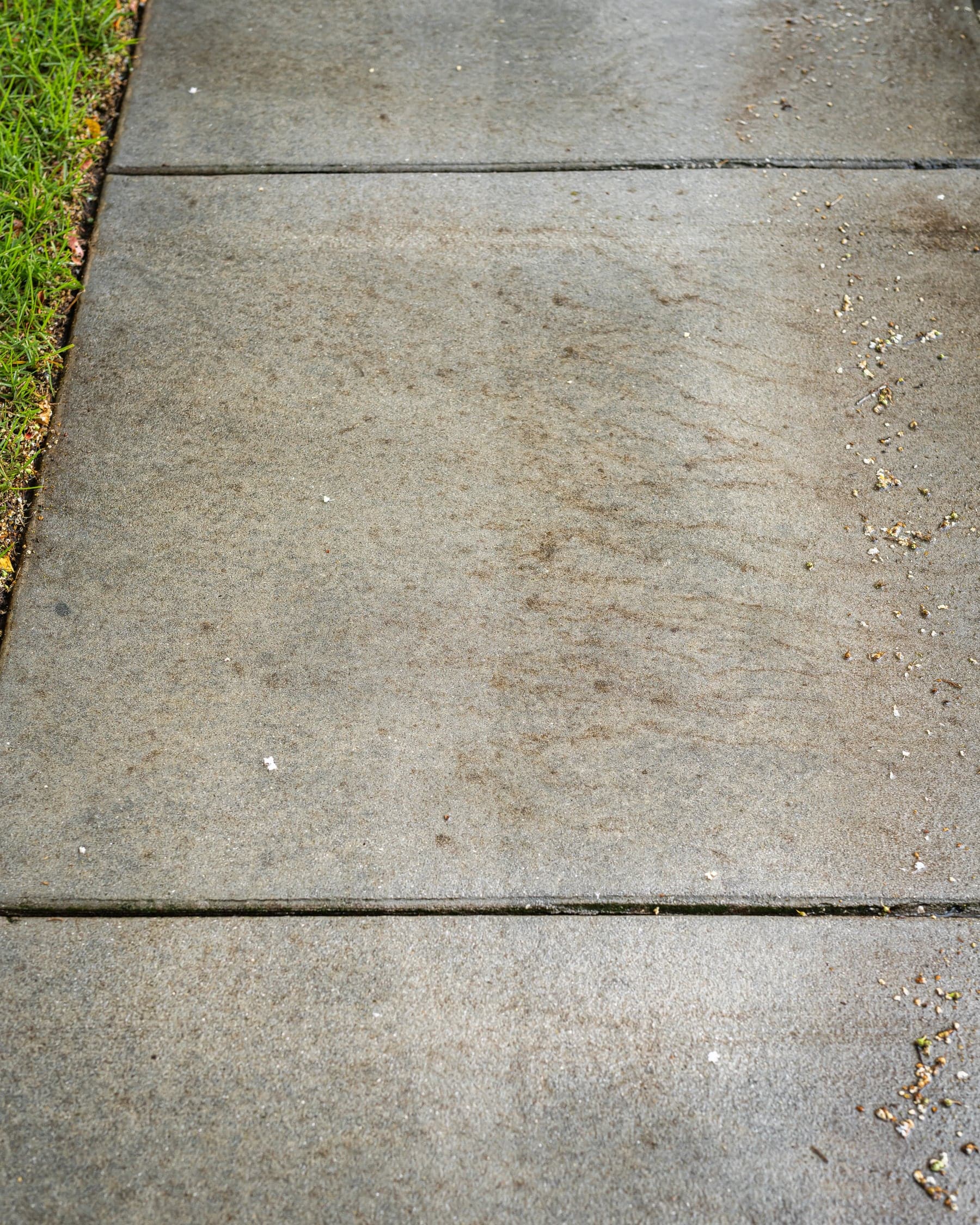
You manage a shopping center off Sam Rittenberg, or a restaurant block near Coleman Boulevard, and somebody washed your sidewalks last quarter. They came back striped. Light bands, dark bands, a scalloped edge every few feet where one pass overlapped the last. From the parking lot it reads as workmanship, because dirt with a pattern in it looks deliberate.
That striping is what a hand-held wand leaves on flatwork. It is not a sign the crew needed more pressure. Nothing held the nozzle at a steady height and angle while a man walked backwards. Two things fix it: a surface cleaner, a shrouded housing with jets on a rotating bar at a fixed height, and hot water when the soil is grease or gum.
The stripes are a geometry problem
A jet does not clean everything in front of it. It cleans a band, and past that band it does very little.
A peer reviewed study in the Journal of Materials Processing Technology separates water jet cutting from water jet cleaning: cutting is penetration of a solid material, cleaning is an erosion process that lifts deposits off the surface. You are not supposed to be cutting the concrete. The same paper puts the optimal stand-off distance at about five nozzle diameters, has the jet losing its cleaning ability out around twenty-six, and finds too close is wrong as well, because the rebounding jet obstructs its own flow. Debris outside the jet's cleaning radius was not removed at all. Read the shape of that, not the numbers. It was one round converging nozzle in a lab rig, run at nozzle inlet pressures of 2.07 to 4.96 MPa, about 300 to 720 psi, not a fan tip on concrete.
Now picture a man with a wand. Distance changes with every step. Angle changes across the arc. Speed changes at the end of a pass when he resets. Every one of those lands somewhere on that curve, and the slab keeps the record.
Pressure is one of two numbers on the machine
The industry's own standards body does not rate machines on pressure alone. PWMA PW101-2010 is titled "Standard for Testing and Rating Performance of Pressure Washers: Determination of Pressure and Water Flow", and it defines a pressure washer as a device producing at least 500 psi and at least 1 gpm. Both numbers, or it is not a pressure washer.
Time in contact is the third variable, and no spec sheet lists it. In the cleaning literature, removal of a soiling layer is attributed to a combination of shear stress, material transport and soaking, soaking meaning time spent in contact with the solution. That work used coherent jets on smooth lab walls at flow rates far below a pressure washer, so I will not hang gpm figures on it. The principle holds. What the water does running away from the impact matters, not only the hit.
What a surface cleaner does that a wand cannot
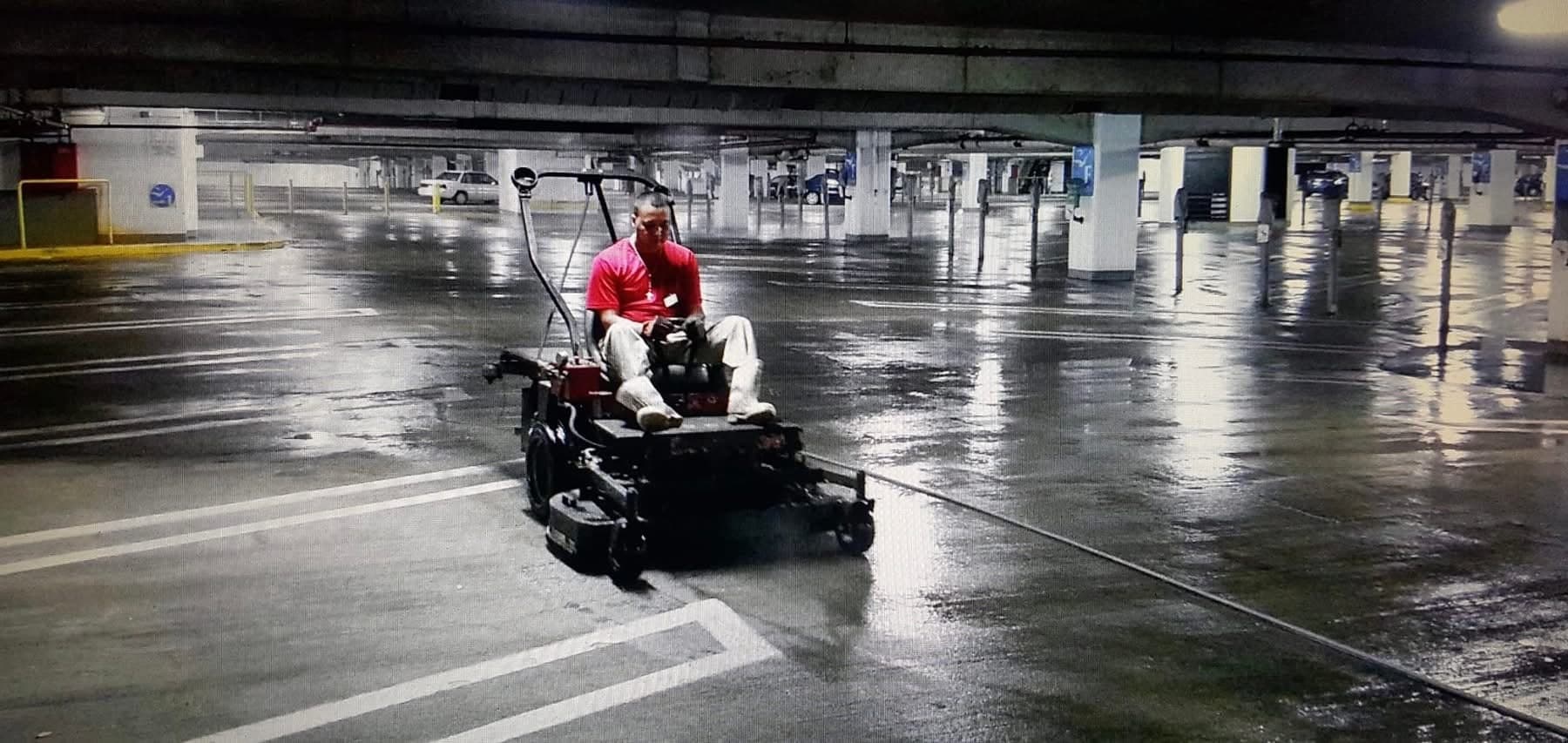
It holds the jets at one height and one angle and spins them, so every square foot gets the same treatment for the same length of time. Overlap is set by the machine, not by somebody's shoulder. That is the whole trick.
The shroud helps twice more. It kills the fan of dirty splash, which matters on a storefront at nine in the morning with customers walking past, and it drives water to a controlled edge so the crew can recover it instead of chasing it toward a storm drain. That matters most around food waste, which is why we wrote separately about wash water and stormwater rules on a dumpster pad.
Grease on a restaurant sidewalk is a heat problem
Back door grease is fat. It walks out on shoes, drips off a cart, lands on the walkway under a hood exhaust. Fats have real melting points. NIST puts palmitic acid at 335 K, about 143 degrees F and stearic acid at 341 K, about 154 degrees F, both pure compounds in a laboratory rather than the film on your sidewalk.
There is no published temperature at which grease releases from concrete. None. If a contractor hands you a threshold, he read it on a blog. What the melting data tells you is the neighbourhood, and cold water is nowhere near it. Hit a fat film at ambient temperature with high pressure and you spread it, gloss it, and drive some of it deeper into the pore structure. That is the smear outside every cold washed restaurant.
Heat plus detergent is the recognised approach. The joint SSPC and NACE standard for surface preparation of concrete says at section 4.2.3 that detergent water cleaning and steam cleaning may be used to remove oils and grease from concrete. These machines are rated by outlet temperature: Mi-T-M publishes one industrial model at 3000 psi, 3.5 gpm and a maximum outlet temperature of 225 degrees F. One model from one manufacturer, but it tells you the class of tool. We run plant-safe surfactants and biodegradable detergents through ours, which matters where landscape beds sit tight to the walkway.
Gum is not a food soil
Gum defeats degreasers because it is not grease. The federal food additive rule for chewing gum base lists the synthetic masticatory substances it may contain: butadiene-styrene rubber, butyl rubber, polyisobutylene, polyethylene, polyvinyl acetate, paraffin, petroleum wax. That same rule also allows natural latices like chicle, softeners including stearic acid and lanolin, and anything generally recognized as safe in food, so a degreaser does get some traction. Not on the part that matters. The rubber and polymer backbone is what stays stuck to the slab, and detergent chemistry aimed at organic soil has nothing to grab there.
So the public bodies paying for gum removal use heat and mechanical action instead. Cumberland Council in the UK described a machine that lifts gum with brushes, steam and a non-toxic vegetable-based water additive, bought with a grant from a taskforce that exists because gum producers agreed to invest up to 10 million pounds over five years on historic gum litter staining. That is the United Kingdom, not here. But when an industry-funded national clean-up scheme went shopping for a fix, what it bought was steam and brushing.
No published dwell time or temperature exists for gum on concrete, and I am not inventing one. Heat, dwell, a pass with the surface cleaner, then hand work on what stayed. Entry aprons hold far more gum than the middle of a walkway, so budget the labour by where people stand still.
What hot water will not touch
Rust is chemistry. The procedure attributed to the Portland Cement Association and repeated by a cooperative extension service is a pound of oxalic acid powder in a gallon of water, soaked on the stain two to three hours, then rinsed while scrubbing with a stiff broom. Heat is no substitute. Battery acid tracks off a forklift behave the same way.
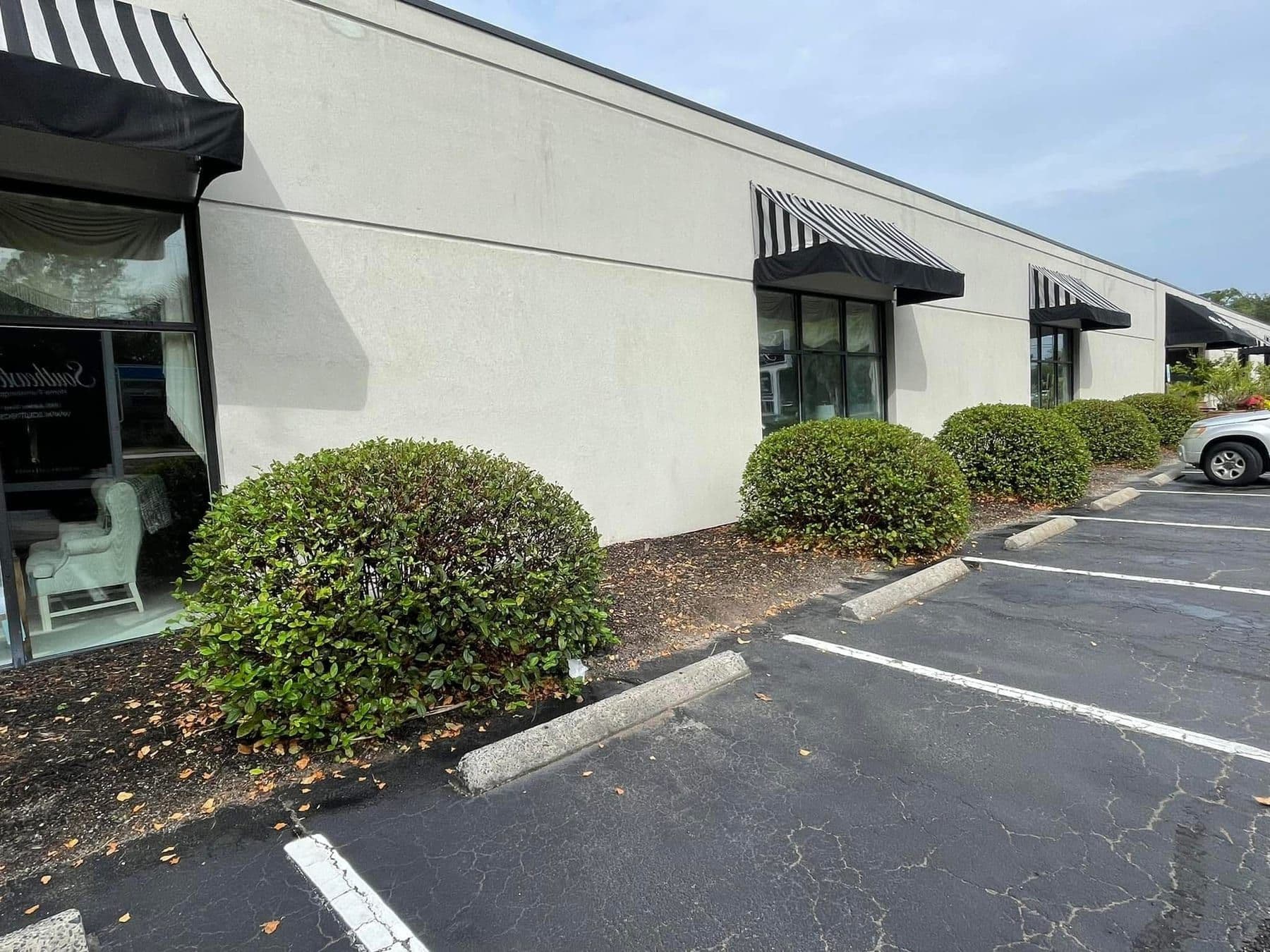
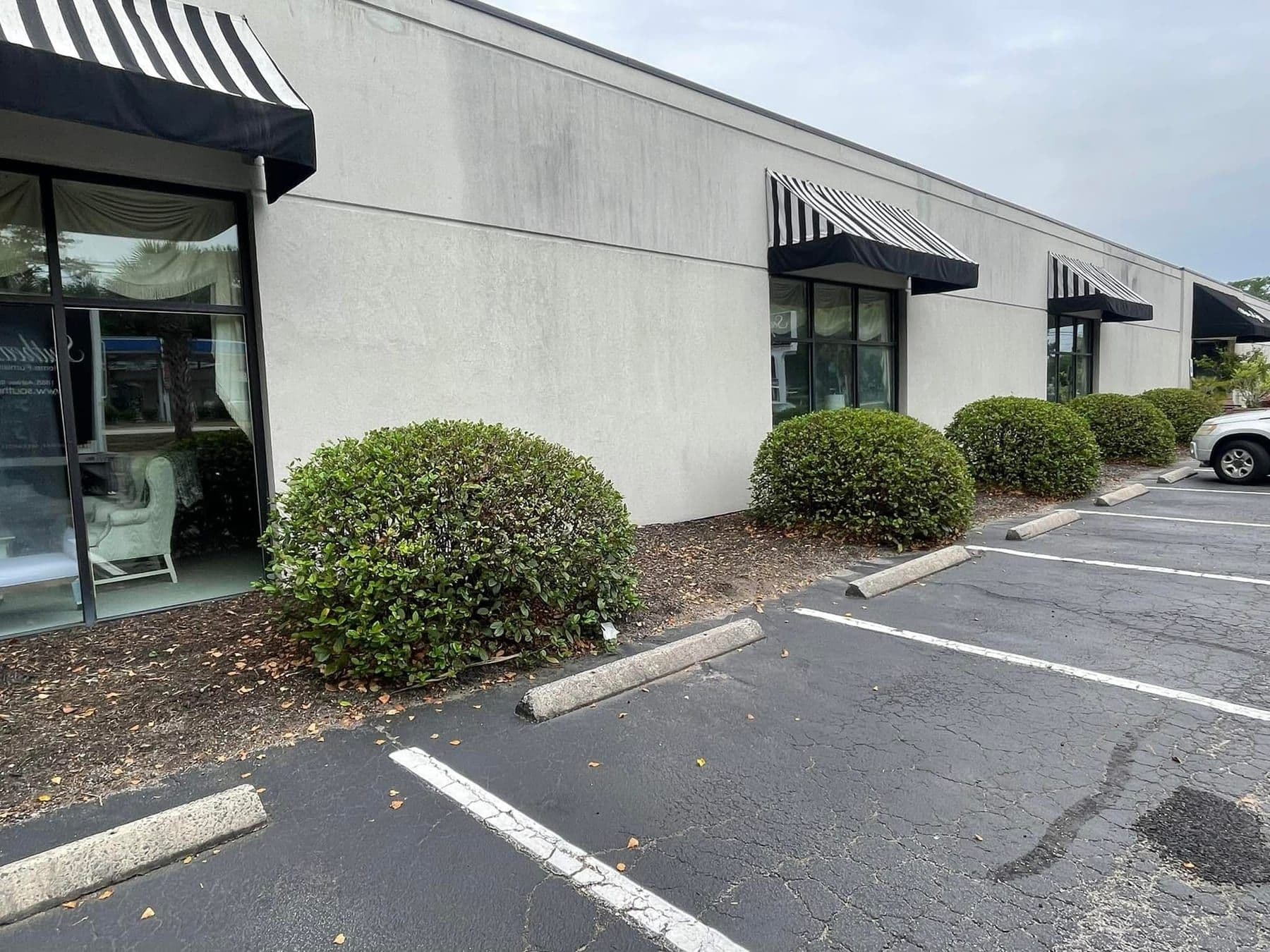
Paint does not come off with heat, and neither does staining worked into the pore structure over years, the dark shadow under a dumpster or at the foot of a downspout. The SSPC and NACE standard says flatly that surface cleaning methods will not remove laitance or contaminants. That sentence is about concrete being prepared for a coating rather than about appearance, so read it in context, but the ceiling is real. Washing restores a surface. It does not reset it. Anybody who promises an old pad will come back new is guessing, which is why our Commercial Concrete Cleaning scopes say in writing what we expect to move and what we expect to leave.
Write the acceptance criteria yourself, because no standard exists
I went looking for a published standard defining how clean maintained commercial flatwork should be. There isn't one. Every concrete cleanliness standard I found is a coating preparation standard. SSPC-SP 13 and NACE No. 6 says in its foreword that it covers preparation of concrete prior to the application of protective coating or lining systems, and its acceptable surface is one fit to receive a coating. Nothing published defines a clean sidewalk at handover.
So the criteria have to live in your scope of work:
The area, with boundaries. Square footage and a marked up site plan, not "the sidewalks."
Soils in scope and soils excluded. Grease, gum and general soiling in. Rust, paint, tire scuff, spalled or sealed concrete out unless separately priced.
Method by area. Surface cleaner on open flatwork, wand restricted to edges and detail.
Hot water anywhere there is food traffic.
Photographs from fixed camera positions, same angles, in daylight, before and after.
Wash water handling, the discharge point, water and power source, and who pays.
Hours written around delivery windows and opening times, and the reclean window in days.
A certificate of insurance before the first visit. We carry two million dollars in general liability, send the COI up front, and can name your ownership entity as additional insured when a management agreement requires it.
On a Shopping Center Cleaning program, add a line naming who cleans the strip in front of each storefront. Read your own lease before you assume, and call the municipality if the walkway is public.
Where our own method falls down
A surface cleaner needs a reasonably flat, continuous surface, and Charleston flatwork moves. Roots lift panels, fill settles, old patches sit proud, salt and age spall the top layer. On broken sections the housing rides the high spots and the skirt drags or skips, so we go back to a wand there, which puts back some of the unevenness I have spent this whole post complaining about. On badly spalled concrete we back the pressure down as well, because pulling loose aggregate out of a failing slab is not cleaning it. We say that before we start rather than after. If something is not right, our crew comes back.
What I would do next
Walk the property at the hour your customers see it, not at 7 in the morning when the light hides everything. Photograph your two worst areas and write down what the soil actually is: grease, gum, staining, or all of it at once. Then get a scope that names those areas.
If you want ours, tell us about the property and ask for a scope and a certificate of insurance, or call 843-696-4739. Hire somebody else if their number is better, but hold them to written acceptance criteria either way.