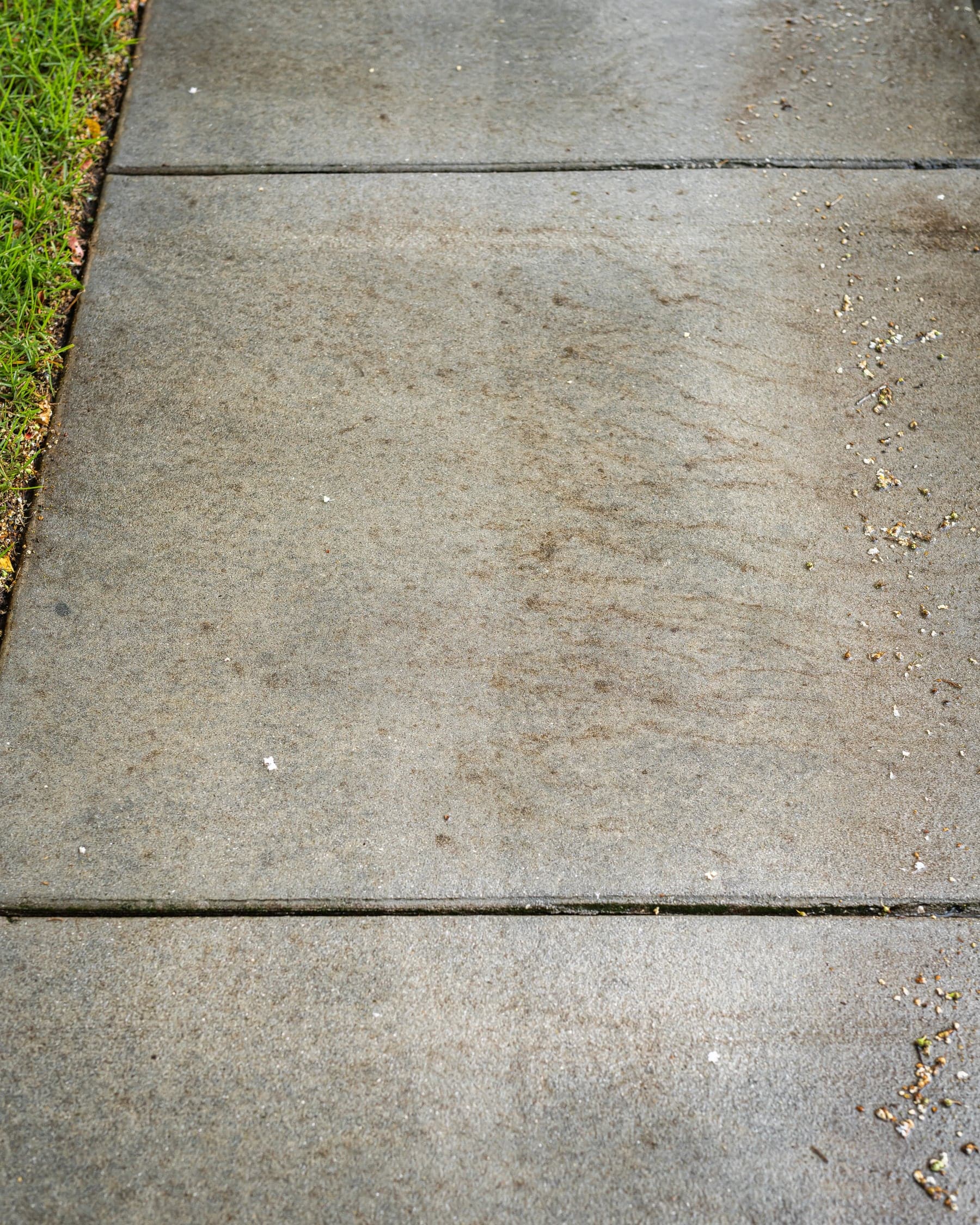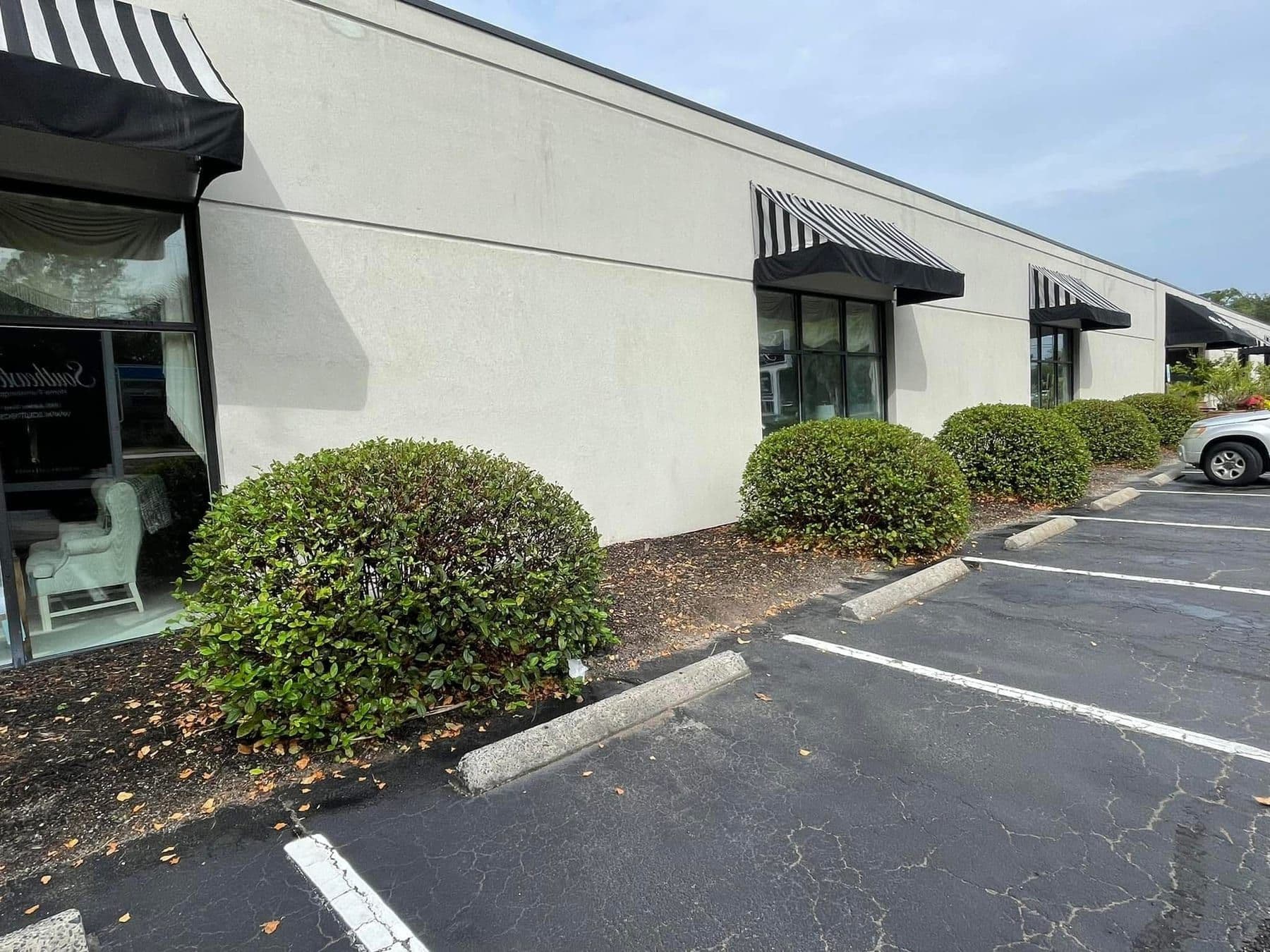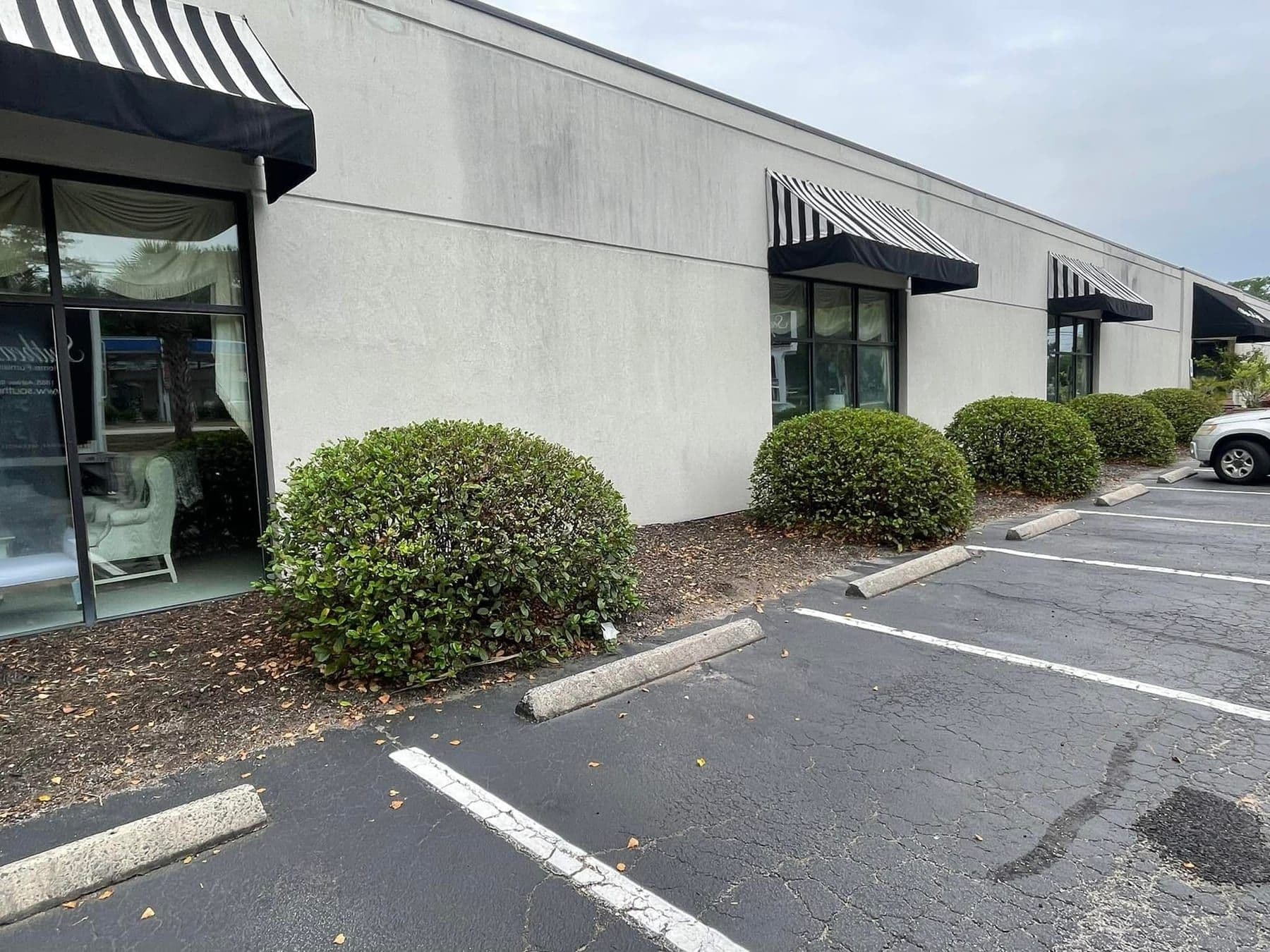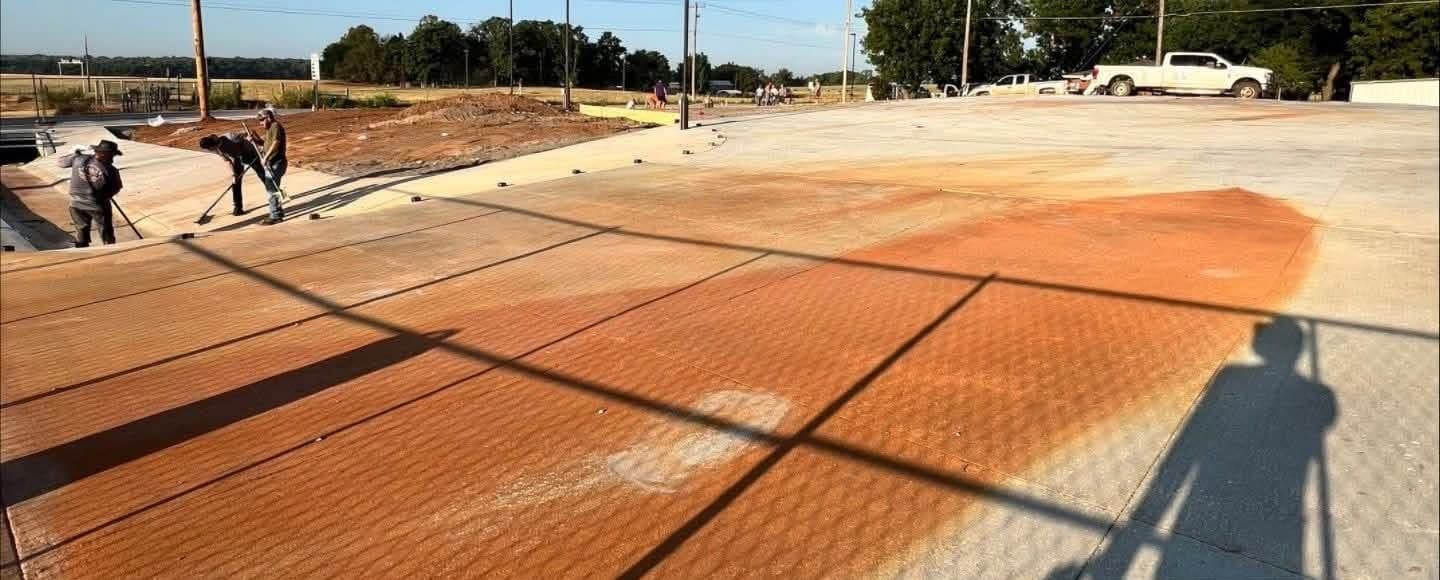
You have an orange bloom on the walkway outside a tenant space. Somebody ran a surface cleaner over it, it lightened, and it came back. Here is the part nobody explains: rust is not soil sitting on your concrete. It is iron inside the pore structure. A surface cleaner works the top of the slab, and the stain is not on the top of the slab.
Rust comes off concrete with chemistry, matched to the substrate and tested somewhere nobody looks first. Pressure and abrasion do remove rust, but only by removing the layer of concrete the rust sits in. That is a different job than cleaning. Scope it as one.
Pressure removes rust by removing concrete
The National Research Council of Canada wrote the plain version of this in 1972. Concrete "is porous and the hydrated cement in it has a very high surface area," so stains "tend to soak into it on contact" (NRC CBD 153). On iron rust, that digest says you can go at it directly with sand blasting or water jet treatment "if roughening of the concrete surface is not objectionable."
Read the condition twice. Blasting does not fail on rust. It works by spending your surface.
The Concrete Masonry and Hardscapes Association says it harder. With abrasive cleaning "the objective is not to wash away surface contaminants, but to remove the outer portion of the masonry in which the stain is deposited," and that sandblasting "can accelerate deterioration by increasing surface porosity" in some cases (TEK 08-04A). A more porous slab takes the next stain deeper. Their rule is "the mildest cleaning method that will satisfy should be chosen." Mine too. And if a bidder quotes a psi ceiling at you on rust, ask what it was written for; CMHA's 400 to 600 psi figure comes with a 12 inch standoff and a 45 degree angle, which only make sense on a wall.
Where the iron is coming from
Irrigation water
USGS reports that low oxygen conditions in the surficial aquifer that runs under parts of Florida, Georgia and coastal South Carolina "can result in the release of naturally occurring iron and manganese from minerals into groundwater," with iron high against the aesthetic benchmark across about 50 percent of the study area (USGS Fact Sheet 2022-3035). That is a regional estimate from 45 public supply wells, not a Charleston number. EPA sets the secondary standard for iron at 0.3 mg/L and lists among the effects above it "reddish or orange staining" (EPA). South Carolina's 2021 assessment confirms tri-county groundwater is drawn for irrigation (SCDNR Report 64), but the wells it sampled sit in the deeper Charleston and Gramling aquifers, not the shallow one USGS describes, and it did not analyze iron at all.
The chain stops one link short of your sidewalk and I will not pretend otherwise. What we see is an orange arc matching the throw of a spray head, back on the same arc after a cleaning. Retail centers off Rivers Avenue and newer buildings out in Nexton share the layout: irrigated turf butted straight against concrete.
Iron in the fertilizer
Landscape crews use iron to green up turf. Louisiana's extension service warns that "Iron sprays can stain concrete surfaces," and that granular iron oxide products "may temporarily darken the soil surface or even stain sidewalks" (LSU AgCenter). That is lawn guidance, so take the mechanism. The commercial version is a broadcast spreader running a turf island beside the walk, granules on the concrete, irrigation on that night.
Metal parked on the slab
Concrete guidance warns off steel wire brushes because they "leave metal particles on the surface of the masonry that later may rust and stain the masonry" (CMHA TEK 08-02A). Same mechanism, bigger objects: steel furniture feet on a terrace, a pallet jack parked in the same aisle nightly, rebar offcuts left after a repair. Conservation researchers describe the pathway as proximity to iron "oxidized by air in the presence of rain," with the dissolved ions carried onto the surface (Heritage Science). Marble study, so take the mechanism, not the substrate.
What actually lifts it
Rust is not one compound. That same study calls it "a variety of iron(III) oxyhydroxides or hydrated oxides of high stability and low solubility." Low solubility is the whole problem. Water will not carry it away, because it does not dissolve.
Two families of chemistry get iron out of a pore. Chelating agents bind it so it can be carried off. Reducing agents change the iron itself: Fe(III), nearly insoluble, becomes Fe(II), far more soluble, which can then "easily diffuse into the poultice support." A 2024 paper on iron removal from stone puts ammonium citrate and EDTA on the chelating side, oxalic acid, sodium dithionite and thioglycolic acid on the reducing side, and pairs them (Gels, 2024). Which is not how I usually see it written up. Oxalic acid is not the alternative to a reducing agent. It is one.
What the concrete masonry guidance prescribes for rust is not oxalic acid at all: a citrate and glycerine poultice carried in whiting or diatomaceous earth, with sodium hydrosulfite for stubborn cases. No ratios here, on purpose. CMHA warns that most chemicals in that publication "are toxic, carcinogenic, flammable, or generally hazardous and require adequate safety precautions," and NRC notes that a sodium hydrosulphite poultice gives off sulphur dioxide. Contractor work with PPE and containment, not a Saturday project for your maintenance tech. And that oxalic acid recipe everybody credits to the Portland Cement Association is not on the association's site; the body is the American Cement Association now, and its live FAQ gives the whole subject one sentence.
Acid is the last resort, not the opener
CMHA is blunt: "Even weak acids should be used only as a last resort as it dissolves the cement matrix of the masonry beginning at the surface," leaving the face more porous and changing its color and texture. NRC gives the concrete version, that muriatic or phosphoric acid on rust will "impart a slight roughness to the concrete surface." Two rules from CMHA's cleaning TEK belong in your scope of work. "Acids should never be applied under pressure." And "any cleaner with a pH below 4 or 5 should be considered to be acidic in nature," which catches products that never print the word acid.
Which is why battery acid is two problems. A leaking forklift or floor scrubber battery leaves discoloration, and the acid has already been doing to the cement matrix what CMHA describes. The stain may come up. The etched footprint under it will not. We take both halves as rust and battery-acid stain removal, and we say up front which half is cosmetic.
Off concrete it changes again. On marble, travertine or limestone that chemistry can pull calcium out of the stone itself, and GSA's rust poulticing procedure for those stones says it "may cause some etching of polished surfaces but can be corrected by re-polishing" (GSA). Downtown hotel entries are full of stone. Say what the substrate is before anyone bids.
Before anybody touches the slab
Useful whether you hire us or not. Every source here says to test somewhere hidden first. CMHA's version: "No attempt should be made to remove a stain until it is identified and its removal agent determined," and the wrong product "may result in spreading the stain over a larger area or in causing a more unsightly, difficult to remove stain."
Identify the stain, not the color. CMHA's table says a brown stain that survives other treatment should be handled as iron. Brown on flatwork is iron more often than people assume.
Pick the test spot yourself. Behind the corral, under a bench, inside a stair return. Same slab, same age, same exposure.
Ask what the poultice powder is. With acid in the mix, CMHA says the paste "must not be made with whiting (calcium carbonate), ground limestone, hydrated lime, or portland cement."
Agree on the finished look, not only the stain. A treated area can come out lighter than its surroundings, because dirt lifts with the stain or the surface bleaches. On flatwork, budget the whole panel or bay.
Decide where the rinse water goes before it runs. Same thinking as wash water and stormwater rules on a dumpster pad, and easier to settle in the walkthrough than with a hose in your hand.
Fix the source or pay for it twice
Chemistry gets iron out of the pores. It does nothing about whatever keeps putting iron in them.
Irrigation: change the arc, move the head, or shift the timing so water stops landing on flatwork. If you suspect the water, test it. I cannot tell you what your line runs, and I found no published iron measurement for irrigation water in Berkeley, Charleston or Dorchester County. I looked.
Fertilizer: ask the landscape contractor to blow granules off hardscape and back onto turf before the system runs that night.
Standing metal: pads under steel feet, and stop staging the same equipment on the same square of slab.
None of that needs a contractor. Do it and the rust line in your commercial concrete cleaning budget mostly goes away.
What we will and will not promise
The honest limit on our rust work is that it is slow, and on old staining it is partial. A poultice sits instead of getting rinsed off at the end of a shift, so the area stays barricaded longer than a wash takes, which on a busy lot means night work. On rust that has fed the same walkway for years we quote a lift, not a removal. NRC, after covering every method, concludes that deep or long neglected stains "tend to require patience and repeated treatments," and that "in spite of the best efforts, however, some stains leave their mark." Light staining from iron-bearing water is, in their words, "relatively easy to remove." Years of it is not.
The rest is boring and firm. Fully insured with $2,000,000 general liability, certificate of insurance before the crew starts, ownership named additional insured when the management agreement calls for it, plant-safe surfactants and biodegradable detergents on the washing side, and a re-do guarantee if something is not right.
Where to start this week
Walk it early, right after irrigation runs. Photograph where the orange is and where the heads are. If the arcs line up, you diagnosed it yourself, and the next call is your landscape contractor rather than a washer. If they do not, look for standing metal and fertilizer at the turf edge.
For a second set of eyes, send those photos with our quote request or call 843-696-4739, and tell us the substrate, the age of the slab and how long the stain has been there. Recent and light is the version that comes out well.