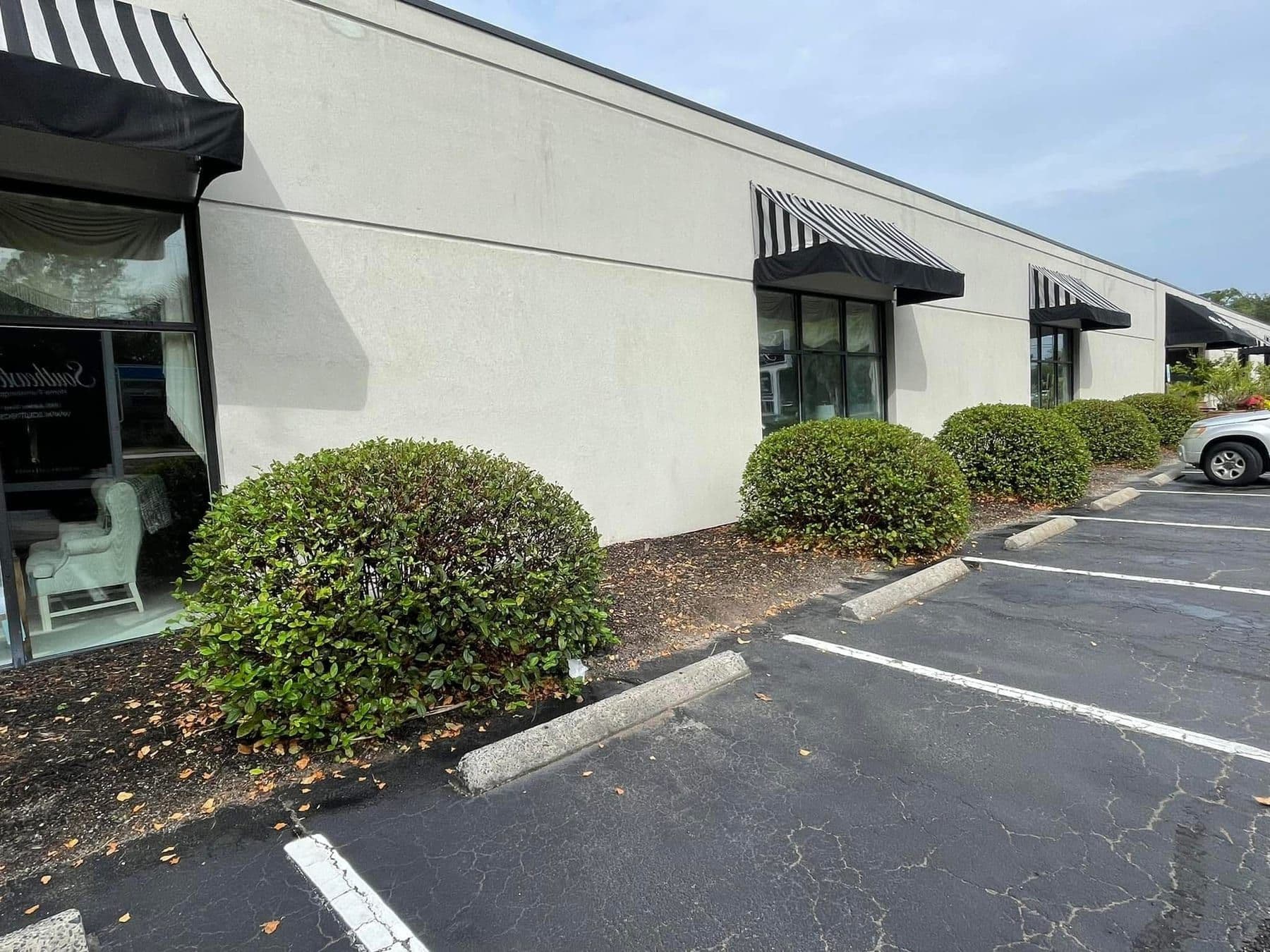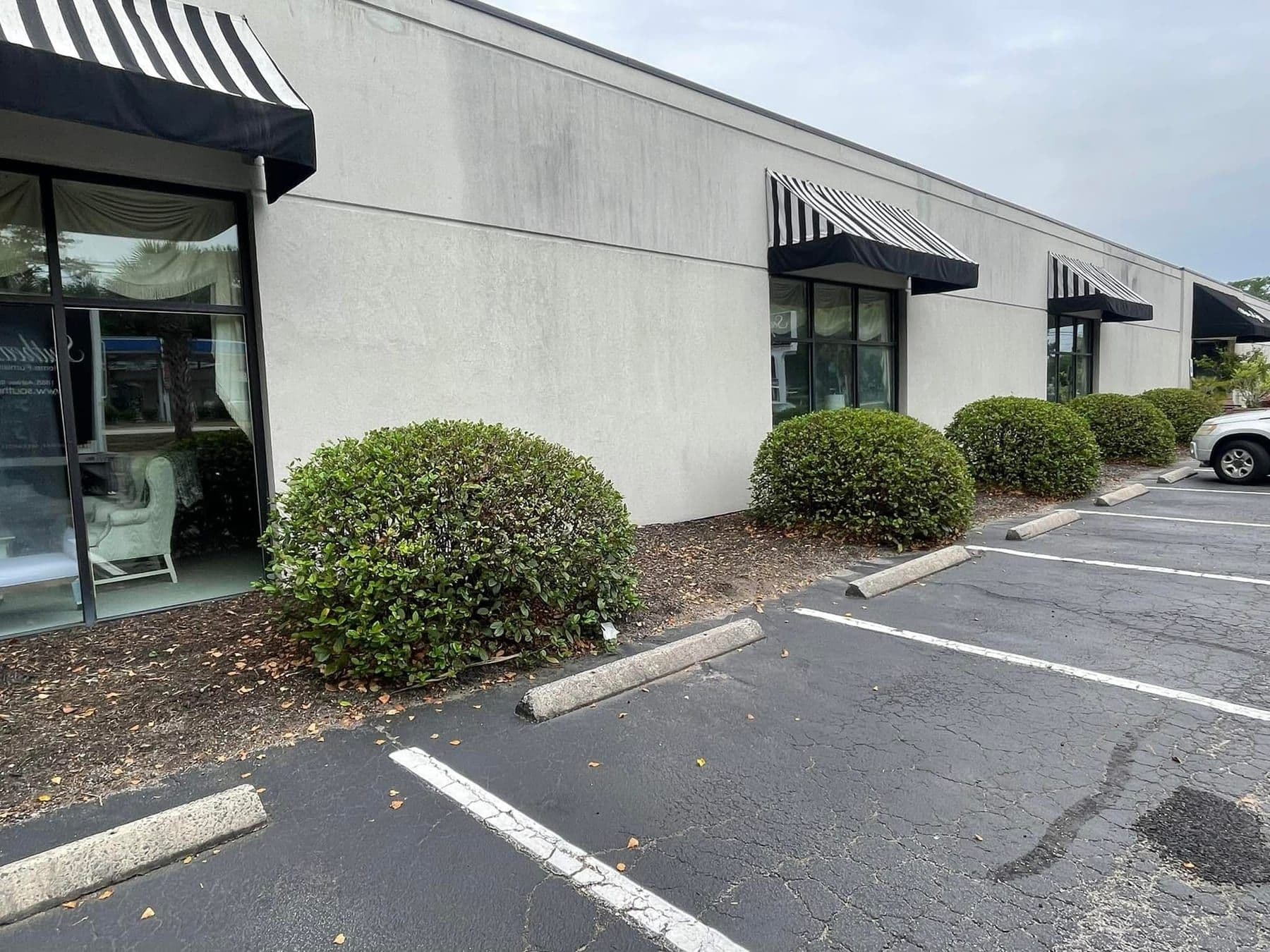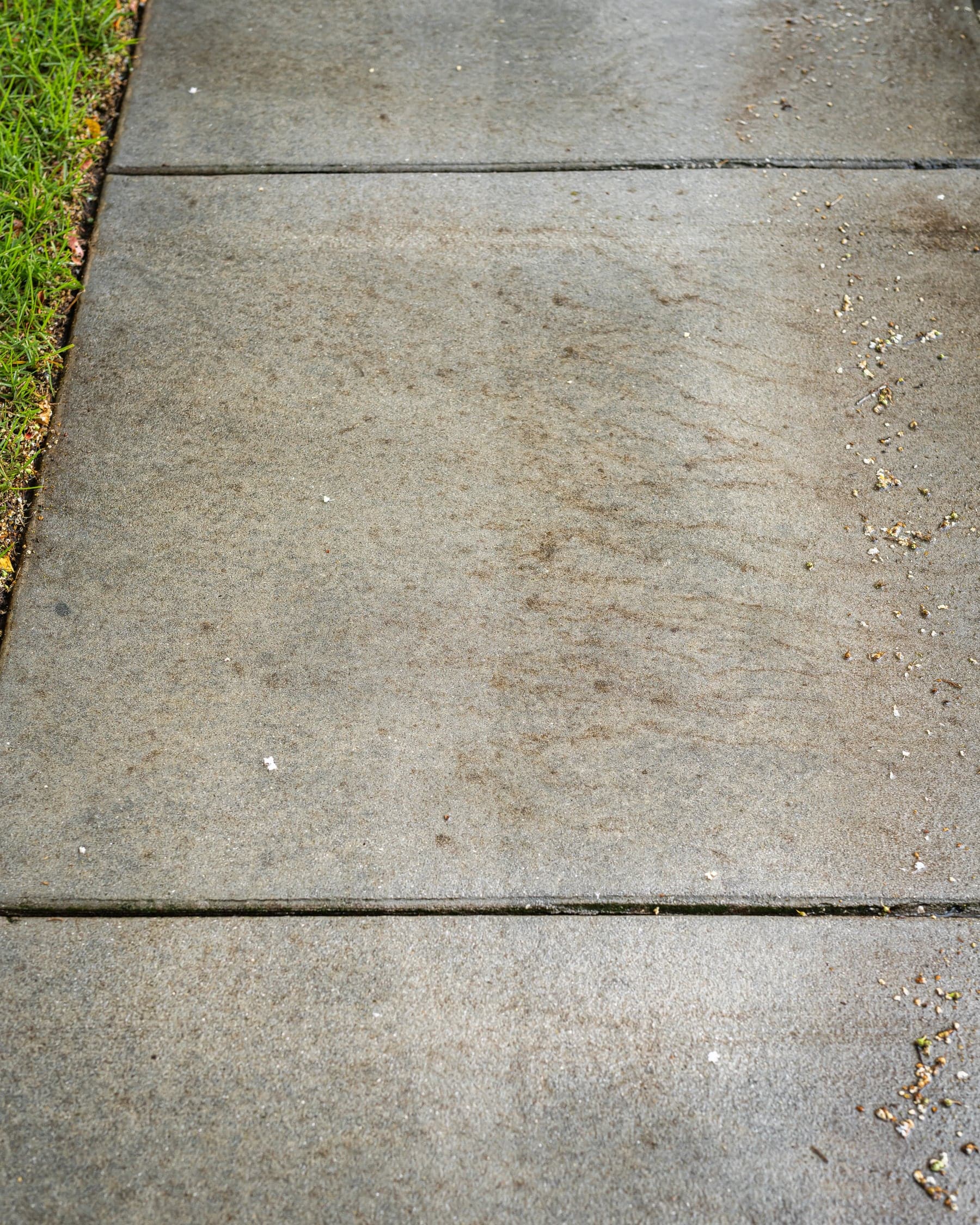
You opened in the last year or two. Maybe out at Nexton, maybe on Main Street, maybe in a flex building up 17-A. Now there is white haze creeping across the brick, orange streaks bleeding off the curb onto sidewalk barely a season old, and gray film on the columns the builder swears was not there at turnover.
None of that means you bought a bad building. New commercial stock fails in its own particular ways: the building is still drying out, the landscaping is brand new, and you are parked under pines. Year one calls for the gentlest method that works, not the strongest one available. Some of it you should leave alone.
The white bloom on new brick is the building drying out
Efflorescence is salt. The Brick Industry Association's Technical Note 23A states the mechanism plainly: water carrying dissolved salts reaches the surface of the masonry, the water evaporates, the salts stay. They usually are not coming out of your brick. BIA points at the alkali content of the portland cement in your mortar.
Under a year old and spread fairly evenly across a wall, it has a trade name. BIA calls that new building bloom, normal evaporation of water after construction, and its recommendation in Technical Note 20 is to allow one year of weathering to remove it. Washing can make it look worse first. Washing adds considerably more moisture, which may bring more salts up, so BIA says do it only in warm, dry weather.
Concrete masonry runs the same way. CMHA's TEK 08-03A says efflorescence is often apparent just after a structure is completed, then gets lighter and less extensive with time unless an outside salt source or repeated water migration keeps feeding it. For poured flatwork I have not found a primary source that pins the timeline down, so I will not invent one.
Bloom that shows up more than a year after construction is a different animal. BIA attributes that to excessive water penetration or poor drainage. Cleaning will not fix it. Find the water.
Mortar smears have a clock on them
Waiting is free right up until it is not. BIA states that after one month, mortar smears and splatters left on brickwork become increasingly difficult to remove. There is a floor too. Mortar has to harden first, and BIA says it is generally best to schedule cleaning at least seven days after the brickwork is completed, with water-only cleaning possible 24 to 36 hours after completion. Put post-construction cleaning in the GC's scope with a date on it.
If somebody proposes acid on new brick, ask which acid. BIA is blunt: do not use unbuffered muriatic (hydrochloric) or hydrofluoric acid. Overly concentrated or improperly mixed solutions can etch brick, dissolve cementitious material out of the joints, cause what the trade calls acid burn, and promote vanadium and manganese stains. Skip the pre-wet and dry masonry drinks the solution, which BIA lists as a cause of white scum and more efflorescence.
Irrigation rust on brand new flatwork
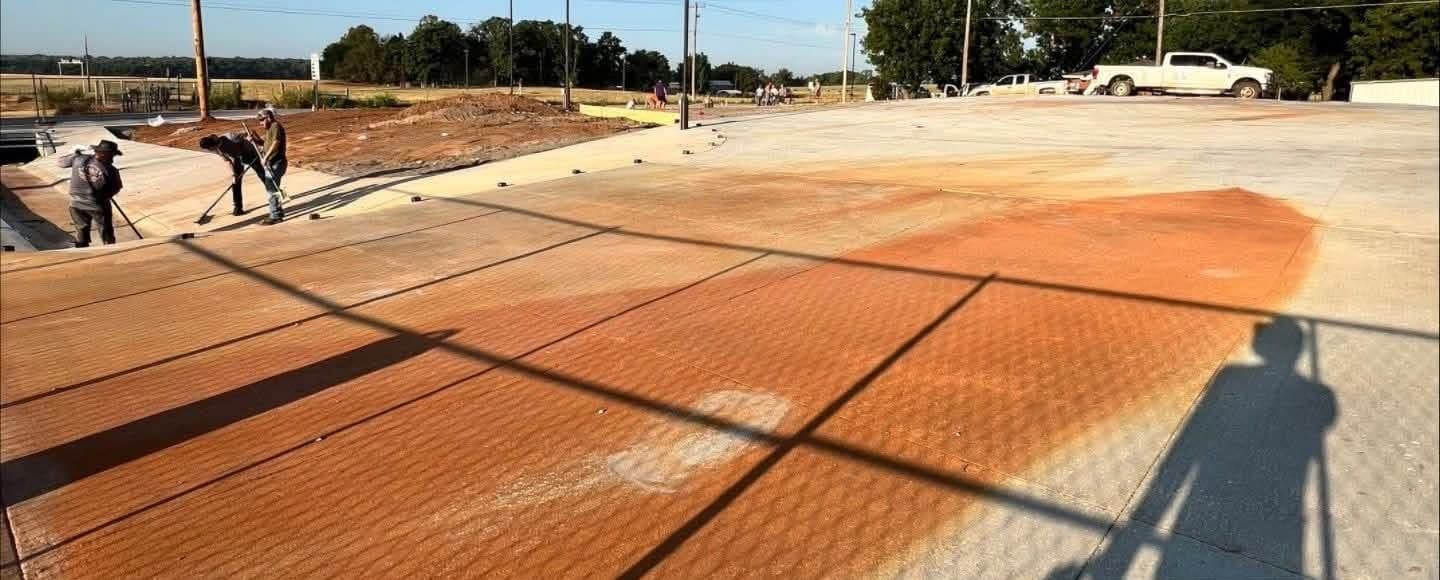
New landscaping means new irrigation, and new irrigation means somebody aimed the heads before anybody cared about the sidewalk. Iron does the rest. EPA's secondary drinking water standards list iron at 0.3 mg/L, with rusty color and reddish or orange staining as the noticeable effects above that level. I have no measurement for the water at your property and will not pretend otherwise. The pattern gives it away anyway: fan shaped, repeating, lined up with a head.
Two fixes, not one. Re-aim the heads, which is your landscaper's ticket. Then treat the stain, which will not come off with soap and pressure no matter how much pressure gets thrown at it. That part is chemistry, which is why Rust & Battery-Acid Stain Removal is its own line item. Around new sod we use plant-safe surfactants and biodegradable detergents.
Pollen, pines, and a canopy that is not going anywhere
Summerville is not thinning its trees for your storefront. The town states a goal of no net loss of tree canopy and has been a designated Tree City U.S.A. for decades. Its tree ordinance page says any tree of any species at eight inches DBH or more, dead ones included, needs a removal permit. That is the Town's rule, and as the next section gets into, plenty of addresses that read Summerville are not in the Town. Call the town or the county before anyone touches a tree.
So plan around the trees. Clemson's Home and Garden Information Center describes the yellow-green coating as mostly pine, late March through April, landing on walkways, vehicles and outdoor furniture in that volume because wind pollination is a numbers game. A good share of commercial pressure washing in Summerville during April is pollen removal. Book it mid-drop and you pay twice. That is most of what we end up discussing with Summerville Pressure Washing clients every spring.
Your mailing address is not your jurisdiction
This one catches people at Nexton. Nexton's own FAQ says the community has a Summerville mailing address but, except for some commercial areas near Nexton Square, sits in Berkeley County rather than the Town of Summerville, with schools, county services and tax jurisdiction all Berkeley County. That is where the growth is, too: Census Bureau estimates have Berkeley County up about 19.5 percent from 2020 to 2025, against roughly 4.6 percent inside the town limits.
It matters for runoff. BIA's cleaning guidance says to control or treat runoff in accordance with the requirements of the jurisdiction, and your jurisdiction may not be the name on your envelope. I am not a lawyer and will not tell you which rules govern your site. Call the county or the town. If you have a dumpster pad draining toward a storm inlet, same question, and I went through wash water and stormwater rules on a dumpster pad already.
The first two years, in order
Useful whether or not you ever call us:
Get post-construction cleaning done in the window, roughly seven days to a month after the masonry is finished.
Trial-clean before anything chemical touches the wall. BIA specifies a 20 square foot sample area in an inconspicuous location, dried before anyone judges it, and says to select the gentlest effective method.
For clay brick, BIA's pressurized-water limits: a stainless steel 25 to 50 degree fan tip, at least 12 inches off the surface, no more than 400 psi at the nozzle tip unless the brick manufacturer permits more, pre-wetting under 100 psi. Above 800 psi it calls high pressure and says is not appropriate for brick.
Those are brick numbers out of a brick document. Nobody should be quoting them at you about stucco, EIFS, painted metal panel or a poured slab.
Light efflorescence often comes off with dry brushing, or a stiff fiber brush and water. Heavy deposits may need a proprietary cleaner used exactly per the manufacturer's instructions.
On interlocking concrete pavers, CMHA says efflorescence may peak as soon as 60 days after installation and does not affect structural performance or durability. To take it off sooner, CMHA points to a proprietary efflorescence remover, buffered to clean without damaging the paver surface.
Keep abrasive blasting off brick. BIA lists it, with high-pressure water cleaning, among methods that etch mortar joints and strip the outer surface of the brick, permanently.
Where we fall short on a year-one building
Our re-do guarantee is real. If something is not right, the crew comes back. On a building that is still drying out, though, coming back is not fixing it. We can pull the bloom off a wall in warm dry weather, do every step right, and watch it return a few weeks later because the wall is still moving salt to the surface. The guarantee covers our workmanship. It does not cover chemistry we did not create and cannot switch off. Inside the first year, with a uniform bloom, my honest answer is usually to wait. Odd thing for a guy who sells washing to say.
What I would do this week
Walk the property with your phone. Photograph every stain and note whether it lines up with an irrigation head, a downspout, a mortar joint, or nothing at all. Write down the date of substantial completion. That is what decides whether you need a cleaner or a repair.
If you want a second set of eyes, send the photos and that date through our quote form or call 843-696-4739. We send a certificate of insurance before work starts, and if your property manager needs to be named additional insured on the $2,000,000 general liability, say so early.